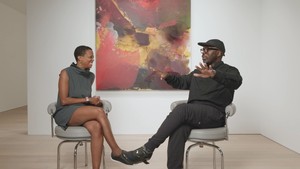
On April 16, the Institute of Contemporary Art, Boston, opened the first midcareer survey of Derrick Adams’s multidisciplinary practice. Covering over twenty years of work, the exhibition, titled View Master, brings together the artist’s painting, sculpture, collage, performance, and video, as well as a vibrant new commission created for the museum’s façade. Ahead of the opening, Adams met with Tessa Bachi Haas, cocurator of the survey, to discuss his formative experiences with television, the impact of his work in arts education on his practice, and the importance of taking a more complex, more joyful, and more expansive approach to Black American life and culture.
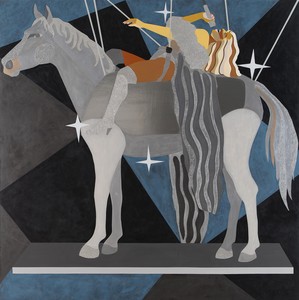
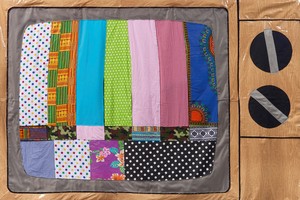
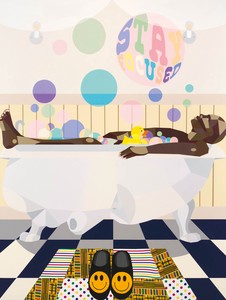
Derrick Adams, When the Stars Align, 2026, acrylic, fabric collage, and glitter on panel in artist’s frame, 96 × 96 inches (243.8 × 243.8 cm)
Derrick Adams, When the Stars Align, 2026, acrylic, fabric collage, and glitter on panel in artist’s frame, 96 × 96 inches (243.8 × 243.8 cm)
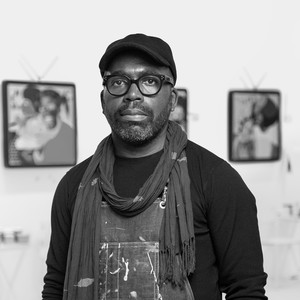
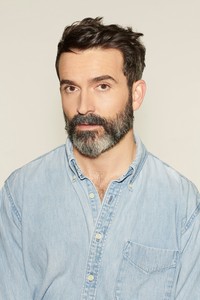
Derrick Adams celebrates and expands the dialogue around contemporary Black life and culture through scenes of normalcy and perseverance. He has developed an iconography of joy, leisure, and the pursuit of happiness with a multidisciplinary practice that encompasses paintings, sculptures, collages, performances, videos, and public projects. Adams synthesizes representational imagery with planar Cubist geometry to produce multifaceted figures and faces that address the richness of the Black experience. Born in Baltimore in 1970, Adams lives and works in New York. Photo: Emil Horowitz
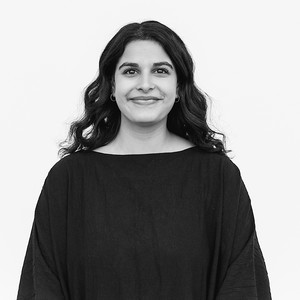
Tessa Bachi Haas is an assistant curator at the ICA/Boston. Her recent projects include Derrick Adams: View Master, the 2025 James and Audrey Foster Prize, Christian Marclay: Doors, and Wu Tsang: Of Whales.
Tessa Bachi HaasLet’s start with your iconic color bars. We’re wrapping the museum’s façade with them, and the bars will greet visitors before they even enter the building. The pattern repeats throughout the galleries. You’ve said in the past that television was your first classroom, and I’m curious what television taught you that formal education didn’t.
Derrick AdamsI only realized later how much of an impact television and media had on me as a younger person. But in my generation, when we talk about our childhood or even about the present, so many different references to TV come up. Outside sports or school, a lot of things that brought people together, at least in my American experience, were rooted in television. Starting from educational programs like Sesame Street or The Electric Company, in the late ’60s, early ’70s, all these educational programs were part of our cultural legacy, and were responsive to and evolved from the civil rights era. The casts were reflective of where the country was going, or of the direction people felt it should go. So as a younger person, the idea of diversity was something I was already introduced to because of television.
But what stuck with me was the imaginative element of these programs, how they introduced important lessons to kids in a very makeshift, grassroots, and theatrical way. They were something I thought about again going through the academic system of art education and art history—looking at Renaissance paintings, looking at modernism, looking at traditional African sculpture—and I found myself asking, What’s my story as a contemporary Black person? How did I experience these shows, as opposed to someone else looking at the same thing—how did they experience this stuff? I realized what a profound impression they’d left on me—they added to my security and self-confidence, because the participatory practice of those programs enabled me to be vocal and expressive. But I also responded differently from most people I spoke to about them. This became a perfect avenue for critical exploration: Rather than just having fun or being entertained, I was really thinking about the social politics of learning. And how can that be extended as an artist thinking about audience?
TBHThese programs taught you pedagogy, they taught you how to teach, and arts education remains a key part of your life. I’m curious how that training shapes the way you’ve approached constructing this exhibition. When I look at our plans for the show, I can really feel this structure and sequencing of ideas. The exhibition tells a story in space, and I feel like we’ve constructed it as this sort of open-ended lesson.
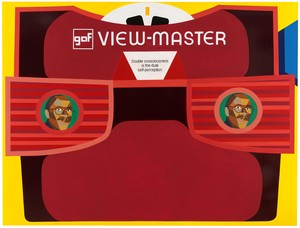
Derrick Adams, View Master, 2025, acrylic and fabric collage on wood panel, 72 × 96 inches (182.9 × 243.8 cm)
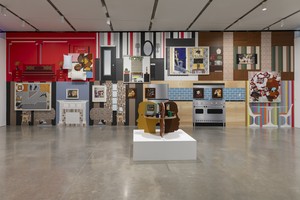
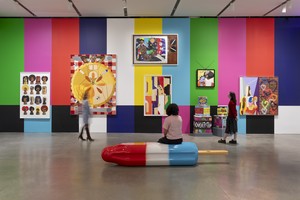
Installation view, Derrick Adams: View Master, Institute of Contemporary Art, Boston, April 16–September 7, 2026. Photo: Mel Taing, courtesy ICA/Boston
DAAll the things I’ve experienced, from creative output to the administration, took shape because of my early education at Pratt [Institute, Brooklyn]. I switched my major there from painting to arts education—I knew I’d be painting forever, so I didn’t think I needed necessarily to be around painters every day. I thought I needed something more substantial, more based on the whys and whats of an artistic practice. I really wanted to understand what was being taught, and for what reason. How was color addressed? How was formalism demonstrated? How was representation introduced? And going into the schools, I started to see how things were outdated. There were conflicts between what was happening in the real world and what students were exposed to in the classroom. I started going to educational stores as an artist, looking through all the visual materials that teachers would buy for classrooms, and I started using those in my collages.
So I didn’t necessarily think of myself as a teacher. I think of everything I do as happening in the research space. I was really interested in, What is the lesson and why are we teaching that lesson? Those television programs and this educational foundation really helped me understand how people see color, what it means, when to implement it. My practice is built on these questions; I’m not a very spontaneous person when it comes to artmaking. There are moments of spontaneity but I’m also very interested in the construction of ideas.
TBHAnd building on the ideas and realities of representation—we have to talk about that, because it foregrounds much of our own practices. With View Master, for example, we talked early on about working with teen programs at the ICA. That’s something I feel responsibility toward as a curator of color. What are your thoughts regarding responsibility toward a next generation, whether it be modeling sustainability in an artistic practice or demonstrating multiple ways to build a life in art?
DAIt’s more about being a public servant in some ways. And my position creatively is to make it as interesting as possible for people who may or may not have had exposure to the things I’ve been exposed to. It’s really just sharing resources. In the creative field, there are two things happening simultaneously: There’s a creative impulse, but there’s also the administrative part needed to gain access to different spaces.
It’s important how you speak about what you’re doing, how you create entry points for people to understand the value of supporting what you’re doing within a larger ecosystem. Looking back, what you learn from an academic point of view is how to talk about your work in a way that other artists understand—theory and process—and those things have been really important for my development as an artist, but it’s necessary to go beyond that for reaching actual audiences. And I think when people feel a sense of lightness or happiness, or the idea of joy, that’s an entry point, and a way to transport them into a space that I’ve occupied, where I’ve drawn from all the different sources that I feel empowered by. My inspirations are usually things that arise from chance encounters.
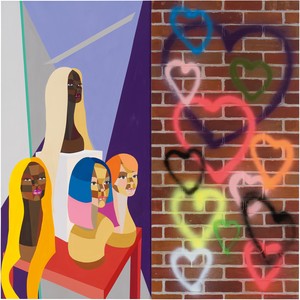
TBHWhen I think of chance encounters, I immediately think of your Style Variation series of mannequins in wigs [2019–]. We started working on the show almost two years ago, and one of the first works on our earliest checklist was from that series. Since then, I walk around and I see the wig shops across Boston—and Philly, when I am back there—totally differently.
DAThose stores are a free exhibition! If you’re walking around, you see them and you’re seeing creativity represented, you’re seeing cultural engagement. Importantly, you’re seeing not only the object but also how the object is activated. You see how the object is inserted in the community it serves. You start to see all these different relationships to consumerism and you start thinking about media and where these wigs show up, whether on TV or in the world. Those stores really activate attention in these ways.
So the thing is, with my work, it’s not like I’m creating something that’s never been created; I’m exalting or highlighting or amplifying existing aesthetic elements, basically saying: Look at this. The way I go about reimagining them only heightens the visual impact of what I’m looking at in a way that an audience may not necessarily have thought about before. Now this wigged head is like eight feet tall, monumental, it’s in your face and taking up your view. And that’s how I felt looking at the originals—I felt like they should be bigger. That body of work is not about hair, to be clear, it’s about style. It’s about the influence of urban culture on consumer products and the fact that these objects are inspired by the people who wear them, not the other way around. The reason this wig looks like that is because the audience that they’re trying to gain has already sanctioned this object as cool. The person who made it didn’t make it cool; the person who will buy it made it cool. The wigs that you see in the street are based on a history of people buying these products, taking them home, styling them themselves. So this whole thing is showing them, “This is what you did; you did this.”
Derrick Adams, Tell Me (Groove Theory), 2024, acrylic and spray paint on wood panel in artist’s frame, 60 × 60 inches (152.4 × 152.4 cm)
TBHIt’s joy, but not in the toxic-positivity sense that everything needs to be happy as a counter to everything that’s horrible. It’s not polemical, it’s about you thoughtfully seeing people in the fullness of their lives. You’ve spoken before about Black visitors leaving museums feeling really heavy and burdened by the repetition of trauma on display—how is View Master constructed to counter this, and to recalibrate what it means to encounter Black life in a museum setting?
DAAs a Black artist, you come to the reality that the complexity of who you are and what you experience often won’t be fully realized in exhibition spaces because of the structures in place and where you fit in, or where people feel you fit in. There’s a certain level of vulnerability that comes with inviting a Black artist into your space and allowing them to have a conversation that may empower a Black audience more than a non-Black audience, but that’s what Black people have dealt with. When I was an undergrad at Pratt, we rarely saw any images of Black artists or Asian artists or women artists in our art-history class. We still had to go to the museum, we still had to write the paper, we still had to do the work, we couldn’t say, “Okay, there’re no Black people in this slide, I’m not taking your test.” We had to go through the whole process of not feeling included but still paying attention to the assignment and finding some positive aspect of the class. We know that there are other artists in the world, but we’re not seeing them in this particular room. So I think the museums should take on the responsibility of letting artists use their space to present what they want the audience to see, and for other people to deal with feeling either excluded or included. Have people ask those questions: What about this exhibition makes you feel like you’re not seen? Do you think other people may have felt this way before?
And of course there are Black artists interested in highlighting the traumatic history of America and the way Black people have been treated. Those shows find an easier place in most major museums because they’re a retelling of a certain history that people are familiar with. And, to be clear, I don’t think they shouldn’t tell it, but I think the same considerations should be brought to Black artists who don’t want to talk about those things, who want to talk about things in a way similar to, for instance, artists like Alex Katz or David Hockney or Bruce Nauman. There’s work that can be addressed in formal aesthetics that still alludes to identity and representation.
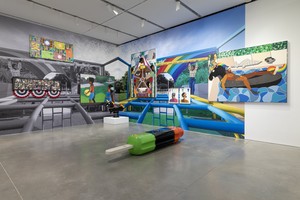
Installation view, Derrick Adams: View Master, Institute of Contemporary Art, Boston, April 16–September 7, 2026. Photo: Mel Taing, courtesy ICA/Boston
Every artist, regardless of their willingness or their acknowledgment, has a position relative to race and politics—if they want to deny it, they can. There are some artists who have the privilege to say they’re doing a painting about color, or they’re doing a painting about . . . whatever, but as Black artists we don’t really have the freedom to speak in that way about the work. I’m taking a lead in making that a possibility. Because, yes, my work is about Black culture. I’m making work from where I’m standing, which is a Black person’s body, and even my most conceptual work is based on my perspective, occupying this world in this body—there’s no way to get around it. But I’ve been able to figure out how to address things that will empower me and people like me, rather than echoing things you can read in a newspaper or look at on social media—usually things that aren’t positive when it comes to our experience: either images of us doing something wrong or of something wrong being done to us. That’s a reality, and a lot of my peers address it very well in their work. But I think there’s a time when people, especially Black people, also need to see how they exist outside those narratives, how our lives can be related through the formal execution of different stories, through color, form, scale—through how to make things. The quality of production is something I personally yearn for in the discussions around my work.
TBHWe’ve talked about formal and also thematic connections across your long practice, and I’m excited that we’ve come to a relatively open floor plan together, which lets visitors make these connections and which privileges both the formal and the thematic. I’d like to return to the color bars, which are coming to the ICA on a monumental scale. The decision to wrap the building in your color-bar pattern feels significant: It’s extending the work beyond the gallery into the public sphere. Boats driving by on the water will see it. Visitors walking by on the street will see it.
DAFor a kid watching television in the ’70s, there were always times when the television program was off and the color bars would come on the screen. This would be before the network stage became public to the audience. I’d always think of the color bars as being this type of curtain, with things happening on the other side of it. The color bars weren’t really about the ending of a program or the beginning of something, they weren’t a void of any sort but something indicating a different world. In the same way, the color-bar wrap around the museum suggests things going on inside the building. You can’t see it as an audience outside, but the color bar shows a level of activity. Beyond that, I was really interested in the way the color bar is the full color arrangement for what we see calibrated on television later on, the raw materials. The colors we see when we look at skin tones or anything on TV come from this image that’s really simplified, but then it gets transferred to a more complex arrangement. The bars suggest some performative element that is existing but may not be visible to the audience.
Installation view, Derrick Adams: View Master, Institute of Contemporary Art, Boston, April 16–September 7, 2026. Photo: Mel Taing, courtesy ICA/Boston
TBHThe work is always happening and you’re giving us a snapshot of it, a calibration. Whether it’s the good or the ugly, you’re giving us a view and insight into it all. And in that sense, you really are our “view master.”
DAYeah, exactly. And that’s why I thought it was the most appropriate title for the exhibition because it speaks to the artist’s ability to craft imagery, to craft reality. I remember that a professor I had as an undergrad said that to be an artist is like being a magician, and your job is to create visual experiences that people believe to be true. I’ve never forgotten that. That’s why my work took this direction, because I realized that true visual power means injecting into the future the way you want people to see you even when you’re gone. The hope is that the impact will drive people to understand how complex and dimensional the Black experience is—it’s not this or that, it’s and, and, and, and, and, and, and—
Derrick Adams celebrates and expands the dialogue around contemporary Black life and culture through scenes of normalcy and perseverance. He has developed an iconography of joy, leisure, and the pursuit of happiness with a multidisciplinary practice that encompasses paintings, sculptures, collages, performances, videos, and public projects. Adams synthesizes representational imagery with planar Cubist geometry to produce multifaceted figures and faces that address the richness of the Black experience. Born in Baltimore in 1970, Adams lives and works in New York. Photo: Emil Horowitz
Tessa Bachi Haas is an assistant curator at the ICA/Boston. Her recent projects include Derrick Adams: View Master, the 2025 James and Audrey Foster Prize, Christian Marclay: Doors, and Wu Tsang: Of Whales.