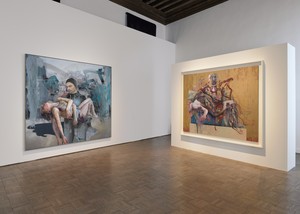
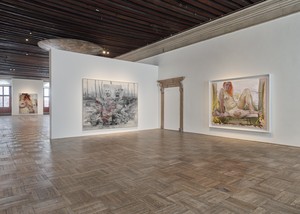
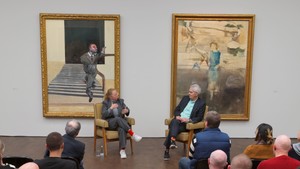
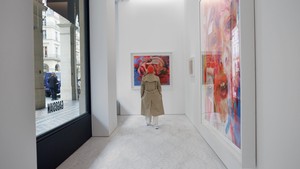
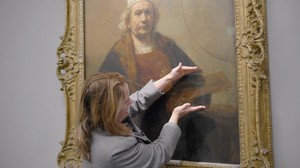
On March 28, a major exhibition of Jenny Saville’s work opened at Ca’ Pesaro–Galleria Internazionale d’Arte Moderna in Venice, bringing together nearly thirty paintings from the 1990s to the present. The exhibition is curated by Elisabetta Barisoni, head of the museums division at Venice’s Ca’ Pesaro, Museo Fortuny, and head of MUVE in Mestre. Saville’s monumental canvases are set in dialogue with the great Venetian artists of the past, creating a unique encounter between contemporary painting and the city’s artistic heritage. Here, the artist speaks with Stefania Ventra, professor with Ca’ Foscari University of Venice, about her early trips to Venice, the radicality of Titian’s painting, and depicting emotional truth.
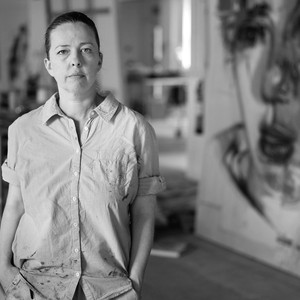
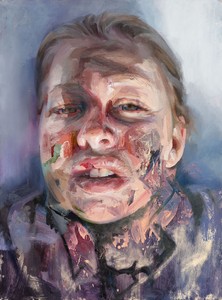
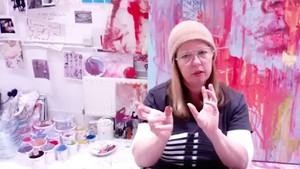
In her depictions of the human form, Jenny Saville transcends the boundaries of both classical figuration and modern abstraction. Oil paint, applied in heavy layers, becomes as visceral as flesh itself, each painted mark maintaining a supple, mobile life of its own. As Saville pushes, smears, and scrapes the pigment over her large-scale canvases, the distinctions between living, breathing bodies and their painted representations begin to collapse. Photo: Paul Hansen/Getty Images
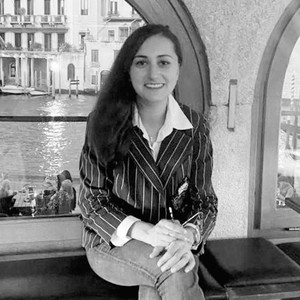
Stefania Ventra is an art historian and Professor of Museology and Art Criticism and Conservation at Ca’ Foscari University of Venice. She has worked at both national and international levels, conducting research on art restoration and the history of art academies.
Stefania VentraIf we were to envisage a comprehensive catalogue of your works, we would be joined by the many artists from the past who comfortably inhabit your drawings, paintings, and sketches. This was demonstrated in an exemplary manner by your recent exhibition in Florence, which placed your work in dialogue with Michelangelo and Botticelli. Now, for your exhibition at Ca’ Pesaro, there is a new challenge: a consideration of the greats of sixteenth-century Venice and the creation of new works that evoke our local glories.
But let’s go back to the beginning. From 1988 to 1992, you studied at the Glasgow School of Art, which continued to espouse figuration while several other British art schools had moved on to a more conceptual approach. Did the program offer a traditional type of teaching? Were you required to copy casts or works by old masters?
Jenny SavilleLife rooms still existed at Glasgow. However, many traditions like mandatory drawing from casts or copying the works of old masters had mostly disappeared. There were still casts dotted around college, but not many students used them.
Glasgow School of Art’s dedicated life room in the Mackintosh building was open until 9pm. The daytime was reserved for life painting, and in the evening life-drawing classes took place. You could organize a group of friends and book a model for a prolonged period, usually two weeks, to work on a particular pose.
SVWho decided the pose?
JSSometimes students, sometimes a professor. As a student you got a main space in one of the painting department studios and then could go and work in the life room as well. The degree course at Glasgow was four years; the first year was a general foundation course where you would try different disciplines, then you applied to the department of your choice: painting, sculpture, environmental art, photography, textiles, and so on. I went into the painting department.
SVOn several occasions, you’ve recalled the trips abroad you took with your uncle during your formative years. You had the opportunity to see many towns, including Venice, and many artworks, which left a deep impression on you.
JSWe went to Amsterdam, Venice, Florence, the Scrovegni Chapel in Padua, Ferrara, and Mantua. There I remember visiting Palazzo Te, with Giulio Romano’s giants painted on an enormous scale.
In Venice my uncle ran an art and art history summer course, which I attended. At 6am a group of us would go to the Rialto fish market to draw, then there were art history lectures, trips around Venice and the surrounding cities that usually related to the morning’s lecture, and sometimes drawing and painting in the afternoons in places like the Ghetto or Campo Santa Margherita. We’d put big pieces of paper on the floor and observe Venetian life.
SVDid you draw from artworks too or only from life?
JSWe drew from the art and life in and around Venice. The first trip was usually to Torcello to see the mosaics, and the course moved chronologically through art history in and around the Veneto.
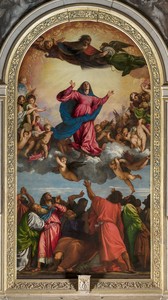
SVYou’ve continued to come here throughout your life, and recently you visited the restoration site of Titian’s Assunta [c. 1515–18] in the Basilica of Santa Maria Gloriosa dei Frari, which was led by Giulio Bono and completed three years ago. All of us who had the opportunity to go up on the scaffolding and observe at close proximity this great array of figures discovered something new about Titian. What was it for you?
JSThere was so much to discover about the painting up close and it was a privilege to visit the restoration Giulio had been working on. Titian’s techniques, such as painting the negative space around fingers to redefine their form—which I’ve also done—were wonderful to see. There were pentimenti from where he chose to move the dynamic of the Madonna’s outstretched arms slightly upward; the rhythm of her red sleeve and blue veil is incredible. From a distance, you can’t see this formal reworking at all, and there are also more nuanced tones within the passages of light. It was like seeing a work by J. M. W. Turner up close, with lemon, blue, and lilac areas that depict some receding putti heads within the yellow/white light.
The halftones throughout the heads and outstretched arms of the apostles in the bottom group of figures were beautifully worked with such rich, tonal depth. The flesh and hair of the putti reflect the color and heat of the blue and red cloth that’s woven throughout the composition. They sit on gray-white clouds, and I liked how he painted their slightly transparent wings and the interchange of pointing hands and overlapping limbs on the left side of the painting. Each area is a mini painting, a rhythmic composition of human and divine behavior.
The drama of the tripartite composition is strengthened using triangular and circular figurative dynamics and through the use of color. Once near, you can see the workings of transitional flesh tones and a soft glow in the half-shadows and reflected light. These two forces—a strong composition and paintwork that’s full of movement—make the painting so utterly magical, with the central Madonna rising in a warm glow and God right at the top observing the earthly action below.
When you compare Titian’s Assunta to the triptych by his teacher Giovanni Bellini next door in the Frari, it makes Titian’s altarpiece look so radical. You could say that Giorgione bridged the gap between Bellini and Titian, but even so there’s quite a painterly shift.
Titian, Assunta, c. 1515–18, restored in 2018, Basilica di Santa Maria Gloriosa dei Frari, Venice. Photo: Matteo De Fina
SVErwin Panofsky, in his famous book dedicated to Titian, devotes a chapter to an analysis of the relationship between him and Ovid. The scholar argues that no artist felt such a deep affinity with the Latin poet since he was, “aware of mankind’s tragic subjection to destiny.”1 Panofsky thinks that Titian is very interested in the tragic, and many scholars believe that a lack of hope is what leads him to destroy form in his late works. What’s your view?
JSTitian articulated the poetics of the tragic in paint. I don’t see him as destroying form—he blurs and interweaves it. He creates psychological narratives—not only through the subject he chooses, but the way he paints. You see this in his later work, like Nymph and Shepherd [c. 1570–75] in the Kunsthistorisches Museum in Vienna, where the painterly surface hums and vibrates. The subject matter is articulated by layering tonal passages, weaving nature together—from sensual flesh to fur, to sky and stag.
There’s no redemption in tragedy; the gods are unrelenting in Ovid’s Metamorphosis if mortals challenge or cross them. It’s the fate of this world, and Titian’s brush articulates that. The paintings are a visual poetic of human nature. They feel embodied in and of nature. This is the capability of painting, and by creating, in some way you resist the tragic and find a way to embody contradictions, especially when dealing with these epic subjects.
SVI also believe it is significant that Titian lived a long life, like Michelangelo, who similarly reached an end marked by profound inner turmoil. This is not the case, for instance, with Raphael, whose early death prevented such developments.
JSIt would be interesting to see what Raphael would have made, had he lived a long, productive life. Michelangelo and Titian both created incredible late works. In the former’s crucifixion drawings, the multiple lines around Christ vibrate as they try and fix on his bodily form. They’re some of the most profound drawings made of that last grasp at life. They embody the commitment in Michelangelo’s endeavor. Titian also made interesting late sketches, but it’s in the later paintings that he works best. It’s the outcome of a whole artistic life spent repetitively making marks, and of a high level of sophistication and wisdom ascertained through skill and years of working, combined with failing eyesight and a weaker body. There’s less control but more knowledge. This dichotomy can make late work so interesting. Some artists have that looser wrist and are still pushing—Edgar Degas, Claude Monet, Cy Twombly, Titian, Pablo Picasso—they all had that.
SVWe can therefore imagine that the exhibition at Ca’ Pesaro will be strongly influenced by Titian, but what about Tintoretto? Rivers of ink have been poured into comparing Titian and Tintoretto, highlighting points of contact, differences, rivalries, and peculiarities between the two. From an artist’s point of view, what most distinguishes their work?
JSTitian has an emotional depth, an instinct for painting flesh and compositional rhythm. Tintoretto’s epic works, especially those at the Scuola Grande di San Rocco, are incredible. He’s a great picture maker; you can feel the urgency and excitement he felt creating these grand scenes. But there’s a solemnity and anchored strength in Titian that makes me look for longer. I like the way he builds form in the later paintings. He uses a scumbling technique to augment the surface tension and his marks are interwoven over time, so colors mix optically on the canvas weave. I don’t feel quite the same pathos standing in front of Tintoretto’s work, but that’s just a matter of personal taste.
There’s a tendency to compare within history: Titian or Tintoretto, Michelangelo or Leonardo, Picasso or Henri Matisse, Jasper Johns or Robert Rauschenberg, Helen Frankenthaler or Mark Rothko, and so on. They are all great, but we seem to have an impulse toward comparison. Titian deploys that figurative/abstract interplay where the materiality of the paint and the rhythm of the figures are harmonious. I feel much more connected to Titian.
SVTintoretto is not on your list?
JSHe’s not on that particular list, but he probably should be, along with many others.
SVI want to ask you about your lists: the two lists of past artists that you keep on the walls of your studio. For someone who studies the reception of ancient artists in the modern era, it is truly a dream to find these in a painter’s studio. Carlo Ridolfi, in his seventeenth-century biography The Life of Tintoretto, recounts that the painter had hung a sign on his doorway that read “Tiziano’s color, Michelangelo’s drawing” to remind him of the models to follow and how to follow them. In your lists, among the old masters, we find Michelangelo, Titian, Diego Velázquez, and Rembrandt. Then later artists appear: Paul Cézanne, Picasso, Jean-Michel Basquiat, and Willem de Kooning. In one of the two lists, you have also included specific notes. For Michelangelo—and I should point out that he is the first name on both lists—you wrote “bring form out from matter.”
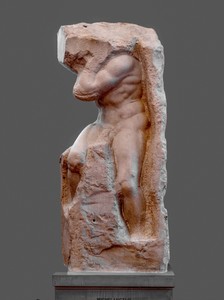
Michelangelo, Atlas, c. 1525–30, marble, Galleria dell’Accademia, Florence
JS“Bring form out from matter” is a phrase I’ve written a few times—it’s what Michelangelo did so successfully in sculptures like Atlas [c. 1525–30]. He carves away to release bodily form, but the remaining rough marble is almost as important as the sculpted, figurative part. I’ve made paintings inspired by this relationship between nature and culture.
Having these lists of names, evocative words, lines from poetry, as well as imagery, creates an atmosphere that I like working in. These artists are my teammates and heroes—I pass by these names and images as I walk around my studio, and it enriches my environment. It’s the connection to a way of life, an inspiration that crosses time and geographies: de Kooning, Picasso, and Basquiat are not so different from Titian and Tintoretto in terms of an artistic life that’s fully committed.
SVLooking at your works, you seem to be interested above all in artists who loved nature and studied reality. Reality, like the one you can find in Rubens, Rembrandt, or Manet—and in Titian obviously.
JSI’m a painterly painter. Painting figures, portraits, playing, and experimenting—being inventive with the language of painting is what I like to do.
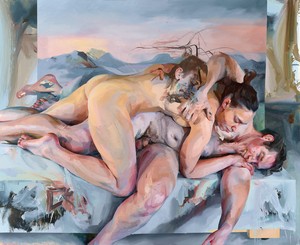
Several figurative avenues have developed in my work over the last few decades: single figures, group figure compositions, portraits, and paintings that refer to ancient and religious art. Figure compositions are one of my favorites—where models show intimate moments like the rhythm of interlocking legs or feet, or the way an arm rests on a leg, for example. Those small, human gestures within a picture create an inner narrative and hopefully a sense of humanity.
SVOur conversation has been entirely devoted to the memory of great men because, as we well know, in the modern era, artistic careers were denied women. I would therefore like to move away from Venice and this period, and go back to a much older model that will finally allow us to talk about women. During the Renaissance in Italy, ancient works that were found, generally underground, were always restored in a way that brought them to a state of completeness. There were very few exceptions, the most famous of which is the Belvedere Torso from the first century BCE, preserved in the Vatican Museums. Its expressive power was considered untouchable and, precisely because of its fragmented state, it has inspired generations of artists.
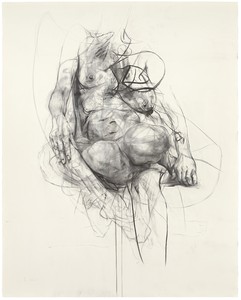
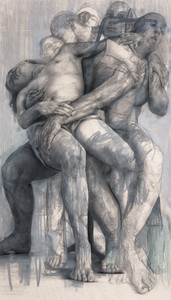
Your Muse on Stool (Study) (2015) seems to evoke that pose and contain the same expressive power, but in a female body. It is as if even this most ancient and iconic representation of the male body, of its strength, despite, or rather because of, its mutilation, has been transformed into the feminine in the hands of an artist who focuses much of her poetics on imperfect bodies.
JSEmotional truth in painting or drawing is what I pursue, whatever the types of bodies the models I’ve worked with before might have. Muse on Stool is a charcoal study of a woman’s knees. Sometimes I depict complete bodies and portraits, and other times I’ve used bodily fragments to create whole figures and new body compositions. In a drawing like this one it was all about bringing form out from the paper and making her knees sit right up. There’s a satisfaction in creating three-dimensionality and bodily form on a flat surface. It’s a silly endeavor I suppose, but something I get pleasure from—understanding a particular person’s physicality. Looking at complete and fragmented sculptures from antiquity like the Belvedere Torso also helps.
In Muse on Stool, all the focus remains on the body because I didn’t draw in the head. This forced me to put as much humanity in the body as I could because the moment you add the head, that’s where the attention goes. Making women’s bodies look powerful is a thread throughout my work.
SVLet’s conclude with a wide-ranging observation. We are living in an age that does not have much love for the historical method or much respect for history. So, why should a young artist working today continue to look to the old masters?
JSIt’s interesting to look at everything, including old masters. They were great at figuration and moving paint around: Titian, Velázquez, Caravaggio, Francisco Goya, Artemisia Gentileschi, Michelangelo . . . there’s a lot of humanity and skill in all these artists. When you consider they are from a small part of the globe in a particular period in history, there’s much to look at to understand our collective civilizations.
A historical sense helps if you want to deal with epic subjects that reverberate through our human story. Understanding the rise and fall of civilizations, political ideologies, religions, and mythology is a foundation. Art from all eras and geographies has informed my work. Ancient fertility goddesses, Japanese printmaking, and Indian sculpture have all been influential over the years. Intuition, a historical sense, and humanity are essential qualities.
1 Erwin Panofsky, Problems in Titian, Mostly Iconographic (New York: New York University Press, 1969), p. 140.
Jenny Saville a Ca’ Pesaro, Ca’ Pesaro–Galleria Internazionale d’Arte Moderna,Venice, March 28–November 22, 2026
In her depictions of the human form, Jenny Saville transcends the boundaries of both classical figuration and modern abstraction. Oil paint, applied in heavy layers, becomes as visceral as flesh itself, each painted mark maintaining a supple, mobile life of its own. As Saville pushes, smears, and scrapes the pigment over her large-scale canvases, the distinctions between living, breathing bodies and their painted representations begin to collapse. Photo: Paul Hansen/Getty Images
Stefania Ventra is an art historian and Professor of Museology and Art Criticism and Conservation at Ca’ Foscari University of Venice. She has worked at both national and international levels, conducting research on art restoration and the history of art academies.