Experimenting with temporal manipulation in his films and videos, Douglas Gordon uses both his own work and that of others as raw material to distort time, disorient, and challenge the viewer. In the following text, Katrina Brown discusses the importance of Douglas Gordon’s 24 Hour Psycho (1993) and some of the films that followed, touching on threads that run throughout the artist’s career.
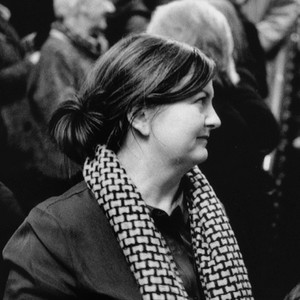
Katrina M. Brown is founding Director of The Common Guild, Glasgow, which presents an international program of artists’ projects, events, and exhibitions. She was Director of the Glasgow International Festival of Visual Art in 2010 and 2012. From 1997 until 2007, she was Curator and Deputy Director of Dundee Contemporary Arts.
From the perspective of the twenty-first century, which gives us constant access to everything everywhere, it’s hard to imagine (or more accurately recall, for those of us old enough) the impact that the domestic videotape player—the VCR—had on how we viewed films: not only what we could watch, but how and when we could watch it, was utterly changed. The technology became affordable in the mid-’70s and commonplace in the ’80s; today it is obsolete. Before its introduction, films were viewed either in the cinema or when broadcast on network TV channels—of which, when Douglas Gordon and I were growing up in the United Kingdom, there were exactly four. As well as introducing the ability to watch films of your own choosing (imagine!) at home, the VCR also of course opened up the ability to control how you watched it; sections could be fast-forwarded, paused—creating the delightful possibility of still images—or even played back in slow motion.
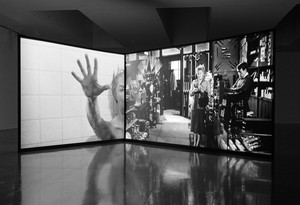
Douglas’s 24 Hour Psycho, made in 1993 and first shown at Tramway in Glasgow, was his first work to use this newfound ability, which he deployed to slow down a single film so that it lasts a full day. The work opens up unseen and unknowable space in Alfred Hitchcock’s Psycho (1960), with previously unremarked details appearing as stills (the film’s extreme protraction meaning that each frame appears on-screen for half a second, where the normal projection speed is twenty-four frames a second). Widespread public knowledge of the film—whether through actually having seen it or not—means that no one need watch it to find out what happens, so the viewing becomes inextricably connected to memory, be it accurate or fallible. As legendary as Psycho is, this transformation plays with our memory and shifts the atmosphere from tense drama to a kind of anxious languor, while still laying bare the irresistible drive to build narrative from the simple succession of images in time.
24 Hour Psycho was certainly an audacious move, and thousands of words have been written about it since. I hardly need add more here, but its genes are in many works that followed while its own significance has only grown. My first encounter with it—projected on a single large screen suspended in the huge space that is Tramway—has certainly proved an indelible memory. It is often talked about as sculpture, and the experience was undoubtedly spatial, but also intensely visual: there is, of course, no sound in the work, though several people seem to recall hearing it—an apt trick of memory, perhaps. 24 Hour Psycho allows the viewer to relish Hitchcock’s exquisitely crafted compositions, and the glorious contrasts among the film’s blacks and whites and silvery grays.
The group of Douglas’s works that followed in 1994 and ’95, including Hysterical and 10ms-1, applied a similar technique to historical documentary footage. I first saw both of these works on a small domestic television set hooked up to a cheap VCR in the Glasgow flat that Douglas and I shared for a number of years in the early ’90s. The slow-motion approach would be stretched to the extreme in 1995 when Douglas developed 5 Year Drive-By, which draws out John Ford’s legendary 1956 Western The Searchers to match the duration of the search referenced in the film’s story. It sets up a real-time experience, then, of the time frame the film depicts. The Searchers stars John Wayne as an American Civil War veteran on a tortuous epic search for his abducted niece, played by Natalie Wood. It is one of the first films Douglas recalls watching, at home with his parents as a child; for some reason that remains unknown to me, there were always Westerns on television at the time, especially on seemingly interminable Sunday afternoons. (And, as Geoff Dyer has written of growing up in the 1970s, “Bear in mind how huge afternoons were back then.”)1 Douglas recalls being perplexed by the film:
How can one film, which lasts only 2 hours, possibly convey the fear, the desperation, the heartache, the real “searching and waiting and hoping” that my father had tried to explain to me when I was younger?
How can anyone even try to sum up 5 miserable years in only 113 minutes?2
His version therefore serves as a tribute to the heroic nature of the quest and the suffering of Wayne’s character. In this instance, one second of cinema time equates to 6.46 hours in real time, or an incredible three frames per hour, meaning that even the most dedicated of viewers is unlikely to ever see more than a few seconds of the original film. It is interminable. Just like a Sunday afternoon at home in the 1970s.
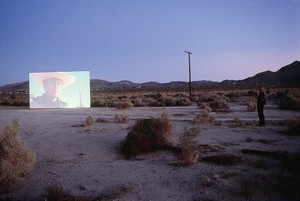
Described by Douglas as “something of a companion piece to 24 Hour Psycho,” 5 Year Drive-By was first shown in part at the Biennale de Lyon of 1995, when it marked a century of cinema. It ran for three months, just a twentieth of its intended duration. It was to find perhaps its most perfect iteration in 2001, when it was shown outdoors in the desert at Twentynine Palms in California, set against the expanse of the arid sun-drenched landscape in which so much of Ford’s film unfolds.
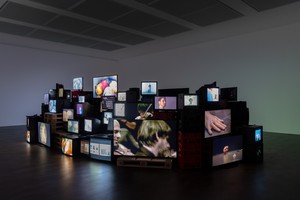
The renown of 24 Hour Psycho has made it a substantial part of Douglas’s biography—shown all over the world, it is regularly cited as a key work of the 1990s. His own history has been a regular thread in his work, through narrative texts, exhibition titles (such as What have I done, at the Hayward Gallery, London, in 2002), and the revisiting of his back catalogue in Pretty much every film and video work from 1992 until now . . . (1999– ), an ongoing compendium work that also saw a return to the TV-format presentation: the videotapes for eighty-two works, with new works continually added, are played on VCRs and on over 100 monitors (or CRTs), like a personal archive or memory bank.
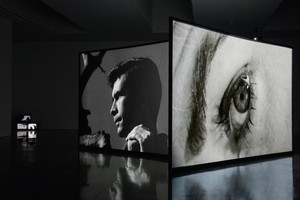
24 Hour Psycho Back and Forth and To and Fro (2008) tackles that first work head on, representing it alongside a divergent twin. The new version, shown for the first time at the Solomon R. Guggenheim Museum, New York, in 2008 and at Tramway in 2010—site of 24 Hour Psycho’s original coming to life—takes the form of two identical screens installed side by side, with Douglas’s film playing in full on each: forward on one, backward on the other, with one flipped left to right such that—at exactly twelve hours in—they present the same images, mirrored, in a kind of exquisite, time-limited film version of a Rorschach inkblot test. More recently at Gagosian in New York, the screens were set perpendicular to one another so that one screen dissected the other a third of the way along it, creating two separate pairings of images. These formats generate some entirely unforeseeable but remarkable juxtapositions, and the tension is intense: what has happened before will also happen in the future, and, of course, vice versa.
The two-screen, mirroring format is familiar from several earlier works of Douglas’s, including Hysterical. His practice has often involved ideas of repetition, inversion, mirroring, doubling, and duality, in what the curator Nancy Spector has called his “perpetual play of opposites.” These are, of course, works made from a position of love: a love of film and a vivid awareness of what Douglas has called the social aspect of watching a film, memories of first viewings and the subjectivity of how we remember them. It’s a love that may twist itself into an obsession, into extreme viewing, but nonetheless allows the objects of his affection to endure, on an imposing scale and with a physical presence that mirrors the scale of their impact on our culture and imaginations.
1 Geoff Dyer, “On Being an Only Child,” 2008, in Dyer, Working the Room: Essays and Reviews, 1999–2010 (Edinburgh and London: Canongate, 2010, reprint ed. 2015), p. 311.
2 Douglas Gordon, “5 year drive-by; proposal for a public artwork,” copy of fax sent by the artist in 1997 and reproduced in Unbuilt Roads: 107 Unrealized Projects, ed. Hans Ulrich Obrist (Stuttgart: Hatje Cantz, 1997).
Katrina M. Brown is founding Director of The Common Guild, Glasgow, which presents an international program of artists’ projects, events, and exhibitions. She was Director of the Glasgow International Festival of Visual Art in 2010 and 2012. From 1997 until 2007, she was Curator and Deputy Director of Dundee Contemporary Arts.