Adam D. Weinberg has been working with Giuseppe Penone on an exhibition of the artist’s new sculptures, The Reflection of Bronze, that opens at Gagosian, New York, on April 22. The works explore the character and possibilities of bronze. Here, Weinberg considers Penone’s enduring engagement with the alloy and addresses the conceptual underpinnings of the exhibition’s three-room structure.
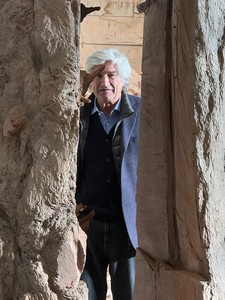
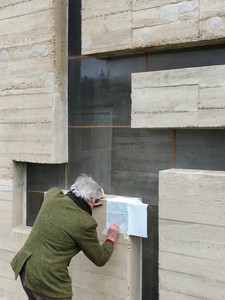
Giuseppe Penone with his artwork at the foundry, Pietrasanta, Italy, 2025. Photo: Adam D. Weinberg
Giuseppe Penone with his artwork at the foundry, Pietrasanta, Italy, 2025. Photo: Adam D. Weinberg
Adam D. Weinberg is the director emeritus and an honorary trustee of the Whitney Museum of American Art; beginning in 2003, he served for 20 years as the Whitney’s Alice Pratt Brown Director. During his tenure, the museum presented some 300 exhibitions on diverse emerging, mid-career, and senior artists—from Edward Hopper and Georgia O’Keeffe to Frank Stella and Carmen Herrera to Glenn Ligon and Julie Mehretu—as well as nine editions of the Whitney Biennial.
Bronze a perpetually imitating material, precious and humble, laden with history
that rises from the earth’s burials, from shipwrecks of the sea
and speaks to us of stories, myths, feelings, lost religions.
Bronze with a solid, austere, strong appearance, but in reality, fragile, sensitive.
Shy, it takes little to wound it and uncover its shining flesh.
Stripped of its dress of dust it attracts our gaze
like a demure body unveiled.
Bronze with a warm, enveloping, harmonious sound.
Bronze, the first material that unveiled the image of man,
mirror of bronze, mirror of man.
—Giuseppe Penone, “Brown, Red, Green, Yellow, Black Bronze,” 2012
How to capture memory, the transient, the ephemeral, the evanescent? How to fix the breath of life, a passing shadow, the flow of time—the consequence of a fleeting thought—in bronze, a material associated with the indestructible, the imperishable?
Bronze: copper + tin + heat. An amalgam, a marriage that is stronger than its constituents. A durable, almost unbreakable substance whose origins extend back some 5,000 years to ancient Asia, Mesopotamia, and Africa. Bronze was first used for weapons and for ritual objects intended to last for eternity. Throughout history, it has been connected to implements of war—spears, daggers, armor, and other weaponry (including in more recent centuries cannons made of gunmetal, a type of bronze)—and to articles of lasting value, including jewelry, ceremonial artifacts, and the coffers in which valuables are stored. Present-day Western associations with the material instinctively and insistently turn to permanence, power, wealth, and victory.
From its inception, bronze was also prized for its unique, adaptable color range and its capacity to record and reify delicate and fugitive qualities. It allowed for a level of finish and precision unavailable with wood and stone. While maces, clubs, torture devices, and instruments of brute force might be fashioned from bronze, so too were sensuous, elegant swords crafted to fine and deadly points. And while ancient coins, beginning in the sixth century BCE, were cast from bronze with durability in mind, they were also decorated with intricate symbols and subjects, including fine tracings of faces and figures that are among the most enduring and tender recordings of history. Consider too the early mirrors produced in the Bronze Age, as well as those of Egyptian and classical cultures, where our ancestors could first contemplate their haunting, transitory reflections, while bronze oil lamps could multiply, heighten, and sanctify the precious, flickering effects of a flame at a time when darkness ruled the night.
These contradictory associations—of the celebration of power and wealth on the one hand and of vulnerability and refinement on the other—have persisted across the centuries and are embodied in monumental bronzes throughout, among them the Artemision Bronze of ancient Greece, the figure of an omnipotent god, either Zeus or Poseidon; the seventeen-foot-high doors of the Baptistery in Florence, produced by Lorenzo Ghiberti in the fifteenth century and bespeaking the power of the Catholic church and the victory of Christianity (the Baptistery may have been built on the foundations of a Roman temple of Mars, god of war); and Rodin’s posthumously cast Gates of Hell (1880–1917), inspired by Dante Alighieri’s description of those gates in the Divine Comedy (c. 1308–21), though lacking his fearsome inscription, “Abandon every hope, who enter here.” Each of these tours de force of metalwork exquisitely captures the living spirit of grand-manner myth and history, religion and allegory.
These associations engendered problems for artists of the later twentieth century. The nineteenth century had seen an explosion of commercial bronze casting to meet popular demands, leading to sculpture that was infinitely reproducible and marketable. A few late-nineteenth- and early-twentieth-century artists found unique, personal ways to use bronze in sensitive, expressive, noncommercial manners, among them Medardo Rosso, whose impressionistic use of bronze emphasized its materiality and ephemeral qualities of tone and luminosity, and Alberto Giacometti, who reinvented bronze as a sculpture not of mass but of space. After World War II, however, many artists, finding themselves facing a crisis of values and the rise of rampant consumerism, rejected expensive materials and the influence of commerce. These artists questioned the fundamental premises of art and representation, focusing instead on the direct, visual, and visceral experience of simplified and essentialized objects.
In the United States in the 1960s, this rebellion took multiple directions, including Minimalism, Post-Minimalism, and Conceptual art. For artists ranging from Donald Judd to Eva Hesse and Sol LeWitt, bronze was definitely not the material of choice, given its association with wealth and with lofty historical subjects. As Giuseppe Penone has remarked, “There was a Minimalist idea about a cultural reset, beginning again.”1 The Italian counterpart of such directions was Arte Povera (Poor art), its name coined in 1967 by the curator Germano Celant, who saw this work as “committed to contingency, to events, to the non-historical, to the present.”2 Whereas Minimalist artists focused on industrial materials, positing a dichotomy between the industrial and the natural, the contemporary and the historical, the Arte Povera artists (somewhat like the Post-Minimalists in the United States) tended to see those realms as a continuum and retained natural and historical materials in their vocabularies.
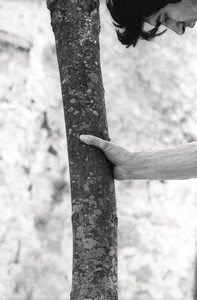
Right from the beginning of his practice in the 1960s, Penone was interested in the potential of bronze. But he recognized the ethos of the moment, with its embrace of the simplicity, availability, and utility of “poor” materials and its commitment to “the primary necessities of art,” and his earliest involvement with bronze was accordingly tentative.3 His halting but growing engagement with the metal is best exemplified by retracing his steps in the development of Alpi Marittime. Continuerà a crescere tranne che in quel punto (Maritime Alps. It Will Continue to Grow except at That Point, 1968), one of his earliest works. In 1967–68, Penone entered a forest surrounding his ancestral home in Garessio, in the Italian Piedmont, and took the unassuming, simple, yet bold action of selecting a young ash tree and grasping its trunk with his hand, partly surrounding its circumference. In effect he was stating the inseparability of human and nature. He would write, “I feel the flow of the tree around my hand placed against the trunk. The altered sense of time makes what is solid, liquid, and what is liquid, solid.”4 (It is worth noting that he describes the flow of the tree around his hand, not the other way around.) He imagined his hand remaining permanently fixed to the tree and the tree eventually growing to surround, incorporate, and become one with it. Photographs were nonchalantly taken to record this action.
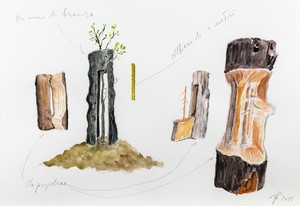
Wanting to realize this work in another incarnation, Penone imagined fashioning a hand and forearm in a material that could remain in place. His first instinct was to cast his own hand in bronze, which he did, but he soon realized that “the hand itself might become a sculptural object [and] I wanted to give the idea of utility instead.”5 (Meaning that he wanted the idea of an object of use, not of the object as visual icon.) Starting to experiment, he made a hand in iron wire, but was not satisfied with it and finally produced a steel hand that he fixed to the tree. In due course, as the tree grew, it gradually engulfed the hand until, in 1985, it was cut down and joined the collection of the Galleria Civica d’Arte Moderna e Contemporanea di Torino, Turin.6 All this goes to say that while Penone rejected bronze for Alpi Marittime, it held a fascination for him early on, and that fascination has grown like the tree outside Garessio, engulfing much of his art from the 1980s forward. Commemorating the importance of this earliest encounter with bronze, and his later full-on engagement with the material, is Trattenere 6, 8, 12, 16, 20 anni di crescita(Continuerà a crescere tranne che in quel punto) (To Retain 6, 8, 12, 16, 20 Years of Growth [It Will Continue to Grow except at That Point]), a reconsideration of that earlier rejection. This touching bronze sculpture literally and figuratively tracks the growth of a tree with a hand around it, in a way that recalls the nineteenth-century motion studies of the photographer Eadweard Muybridge.
Since his first, abandoned engagement with bronze, Penone has gone on to produce dozens upon dozens of bronze sculptures. While a complete account of his nearly fifty-year association with the metal cannot be provided here, a better appreciation of the works in the Gagosian exhibition The Reflection of Bronze demands consideration of his sense of its qualities and potentials. It is further critical to acknowledge that while he is celebrated for his use of and interest in wood, bronze for him is not a more permanent, more marketable substitute for that material. Rather, his use of bronze involves a profound, rich, varied, and lifelong response to enduring artistic questions.
Penone sees bronze as analogous to a living thing such as a plant. For him it reflects the “vegetal gesture of the sculptor.”7 He writes, “Bronze casting is an ancient art that has its roots in an animistic conception of reality. The similarities between bronze and plant life are astonishing and most assuredly have had great importance in the development of the technique of casting. Even today, rods”—the runners that channel the molten bronze in the casting process—“are used to spread the molten metal in different parts of the mold. Bronze is the ideal material for fossilizing plant life.”8 When bronze is “born” by casting, the liquid metal pulses through these veinlike rods, enabling the sculpture to grow and develop.
In another analogy, in the lost-wax casting process a skin forms over the “original” model, which melts during the casting. And as revealed in Penone’s works in wood, the year-by-year growth of a tree involves a skin, the layer added to the trunk each year. Skin is an enduring preoccupation in Penone’s work across media, whether in marble, leather, cloth, paper, or, in the Marsia (Marsyas) installation (2024) in The Reflection of Bronze, for the first time cork. His art is a record of time passing and a reminder that our physical separation from the world is scanty. Moreover, our skin is a means of experiencing and connecting with the world and with others.
As bronze ages, its “skin” changes in color. While metal in contemporary sculpture is commonly seen as antithetical to the natural, for Penone bronze is a living material born from ores of the earth, and the colors that come to life in the patination process are an expression of growth. He has said, “Bronze acquires a color that imitates vegetation very closely. If you put the sculpture outside, it oxidizes in the rain, the sun, and takes on very natural colors, similar to vegetation.”9 When chemicals are applied to give the surface a patina, they don’t form a layer over the material, as the pigments of a painting cover its canvas; rather, the patination emerges through an animate, chemical interaction, the substance physically changes, in what to Penone’s mind is an alchemic process. Oxidation also follows a natural course in the human body, linking object (the sculpture) and subject (the artist); and in considering patination, Penone thinks not only about what the color is but about what it will become.
The Reflection of Bronze focuses on Penone’s most recent encounters with bronze and unfolds in these galleries in three acts.
Act I: Marsia
The first room is devoted to the installation Marsia, that title being the Italian name of the satyr Marsyas, protagonist of the well-known, gruesome and graphic Greek myth of competition, hubris, humiliation, and justice. There are various versions of the story: Most broadly, Marsyas, who is recognized for his virtuosity on the aulos, a double reed pipe, dares Apollo, the god of music, to a contest on the instrument; when he loses, his punishment for the audacity of challenging a god is to be flayed alive and have his skin nailed to a pine tree, or, in another version, used as a wine sack. The myth is an enduring subject in art, from the fifth-century BCE bronze by the sculptor Myron, once installed near the Parthenon, now lost, but known through Roman copies in marble, including one in the Louvre, to paintings by artists such as Titian (perhaps the most famous of all) and subsequently Rubens, José de Ribera, Luca Giordano, and others.
Penone loves myths for their expression of the closeness of humans to nature. He has long been fascinated by the myth of Marsyas and the metaphor of flaying, writing on the subject decades ago in his notebooks.10 In discussing Marsia with him, I learned that a painting of the flaying of Saint Bartholomew has hung in his kitchen for many years.
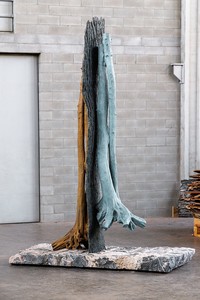
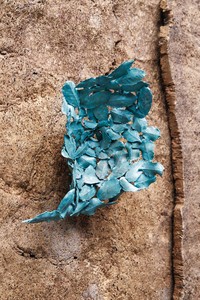
This first gallery in the exhibition comprises several elements: a central sculpture of bronze elements on a granite base; overlapping slabs of raw cork bark that cover the walls virtually floor to ceiling; and, periodically fixed to the bark so as to punctuate the cork-covered walls, pairs of the lower trunks of cast-bronze saplings. Penone has also installed another work here, Pelle di foglie (Skin of Leaves, 2025), a group of abstracted bronze masks cast from acacia leaves, casually interspersed on the cork walls.
The sculpture at the center of this spectacle consists of bronze casts of the same pair of hornbeam saplings, stripped of their bark, given differing patinas, and suspended to either side of a vertical bronze slab cast from a “skin” of bark removed from a mature tree. (The artist chose these saplings as their twisted trunks reminded him of musculature.) One pair of saplings, their patina “natural” brown, rests on the stone base, which is striated with parallel grooves to suggest flowing water. A stainless steel cable connected to the top of this pair straddles the bark slab, which is firmly implanted in the stone, and suspends the other pair of saplings, this pair patinated a luminous teal.
There are infinite readings: Maybe the brown sapling is the tree from which Marsyas, represented by the teal sapling, is helplessly hung? Or do the pairs of trees stand for the competitors in the myth—is Marsia a parable of victor and victim? Or perhaps they suggest Marsyas before his flaying and again after? Balanced around a central fulcrum, might they represent the pair of scales traditionally symbolizing justice? Does the hanging pair of saplings propose an offering to the gods? In any case, the exposed nakedness of the trees, and the midair suspension of one pair, suggest both brutality and pathos.
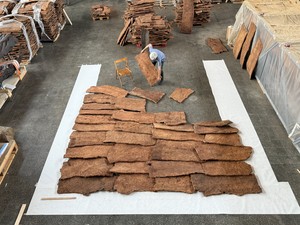
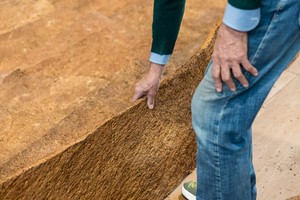
The cork panels on the walls are themselves the flayed skins of trees that the artist personally selected in Alentejo, Portugal. Enveloping the room, their somber tone and texture heighten the drama at center stage. The smaller pairs of branches hung on the walls, which correlate in color with the saplings in the central sculpture—one of each pair with its bark, the other shorn of it—and the hanging masks serve as witnesses to this tragic event. And we who enter the gallery in effect become passive participants as much as visitors.
Act II: Clepsydra and Un anno di bronzo
The second and largest of the three galleries contains a group of four bronze trees each titled Clepsydra (Water Clock), although the artist does not consider them either a sequence or a series—each work is complete unto itself. A clepsydra is an ancient form of clock. The name, deriving from classical Greek, means “water thief”: water was “stolen” as it passed by gravity from a vessel calibrated to track the outflow and so to mark the passage of time. All of Penone’s tree sculptures, no matter the material, are about marking time, and each of the Clepsydra trees is an ode to time’s passage. Like bronze, a water clock harnesses nature by simple technological means—bronze through fire and the clock with water.
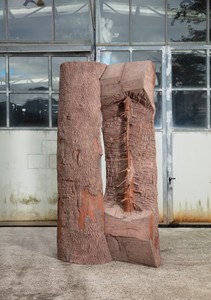
All of the four trees, of similar height and girth (roughly ten feet by three), stand vertically and appear in various stages of undress: In each case, areas of wood have been incisively yet intuitively stripped and “stolen” to reveal an inner being. The Clepsydra works—one dating from 2012, three from 2024—recall Michelangelo’s four celebrated, unfinished slave sculptures of c. 1525–30, works of comparable size in which the artist exposed and “freed” the figures from raw blocks of marble. Each Clepsydra serves as a time machine, returning us to origins through contemplation of interiority. Though made of enduring bronze, the works appear mutable; they are not monuments, not destinations, but way stations in a revelatory process, tokens of discovery. Indeed, each marks a transition from corporeal existence to spirit. For Penone, bronze is not just a testimonial object but part of a living quest for continuity: “I am aware that the deep reason behind any human activity is the survival instinct which is present in our body cells, governs our reproduction instinct, and, through the affirmation of our identity in the world, projects our existence in the future, making it present with the people who will come. Our existence in the future it’s [sic] the aim, the scope and the necessity of the work. Bronze is a material which guarantees this existence.”11
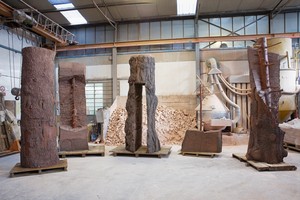
The centerpiece of this room, Un anno di bronzo – Larice (A Year of Bronze – Larch, 2024), resembles its cousins the Clepsydra in scale and concept but was conceived differently. In this work Penone has hollowed out an enormous larch, creating inside it a magical void. We viewers can visually inhabit this interior space, exquisitely rendered through the artist’s manipulation of the casting process to show his sensuous, personal mark-making. The inside of this massive bronze appears like an enormous molten skin and hosts a living sapling that proposes cyclical rebirth.
The tall, lean Albero di 3 metri (3-Meter Tree, 1995)—the only wood sculpture in the exhibition—is positioned poignantly on the sidelines in this room, like a talisman of lost youth. And the Trattenere begun in 2004, a bronze restatement of his 1968 Alpi Marittime, is displayed in the shadows of this gallery, a historical bridge between Albero di 3 metri and the four Clepsydra.
Act III: Riflesso del bronzo
The final act reads as a reflection of both the artist and the viewer, and also constitutes a reflection on the materiality of bronze. This gallery, the smallest of the three, holds a single work, Riflesso del bronzo (The Reflection of Bronze) of 2005, which comprises seven bronze wall panels, each about four feet by two feet six inches—the size of a half-length portrait canvas. The first in the series (reading from right to left in the exhibition) is flawlessly smooth and polished to a highly reflective sheen. The second—cast from the first, using the lost-wax process—captures the artist’s application of wax on the surface of the first, and the casting process has degraded the reflectiveness of the first somewhat, obscuring the viewer’s self-image. With each subsequent panel, each cast from the one before it, the surface becomes progressively more encrusted, like a scabrous skin, and the shape of the rectangle becomes more bowed and deformed.
Riflesso del bronzo constitutes a precise essay on bronze—its characteristics, its uses, its history. The sculpture is closer to Minimalism and Conceptual art than the other works in the exhibition but recapitulates the fundamental questions they pose using multiple materials and subjective and narrative associations. Yet these reliefs more pointedly call attention to process and product. Not merely a series of rectangles, Riflesso del bronzo addresses metamorphosis, what happens in the pause, the conceptual space between nature and culture, art and artifact, history and the present, life, death, and regeneration. It is not about material but about existence. As Penone asserts, “All my work is basically a reflection on sculpture, understood not as a choice of material or materials and then an elaboration of forms but as an attempt to understand reality.”12
1 Giuseppe Penone, in Carlos Basualdo, “A Conversation with Giuseppe Penone,” in Basualdo, ed., Giuseppe Penone, The Inner Life of Forms (New York: Gagosian, 2018), p. 20.
2 Germano Celant, “Arte Povera. Appunti per una guerriglia,” Flash Art, no. 5 (November 1967). This translation from Flash Art’s reprint of the essay, “In Memory of Germano Celant: Arte povera. Notes on a Guerrilla War,” April 29, 2020, available online at https://flash---art.com/article/germano-celant-arte-povera-notes-on-a-guerrilla-war/ (accessed December 3, 2025).
8 Penone, untitled text, 1980, repr. in Ida Gianelli, Sculture di Linfa. 52. Esposizione Internazionale d’Arte, la Biennale di Venezia, exh. cat. (Milan: Electa, 2007), pp. 230–31.
9 Penone, in Buchloh, “Interview with Giuseppe Penone,” 20.
10 See Salvatore Settis, “Sculpting Time,” in Basualdo, ed., The Inner Life, p. 152.
Adam D. Weinberg is the director emeritus and an honorary trustee of the Whitney Museum of American Art; beginning in 2003, he served for 20 years as the Whitney’s Alice Pratt Brown Director. During his tenure, the museum presented some 300 exhibitions on diverse emerging, mid-career, and senior artists—from Edward Hopper and Georgia O’Keeffe to Frank Stella and Carmen Herrera to Glenn Ligon and Julie Mehretu—as well as nine editions of the Whitney Biennial.