From her Judenplatz Holocaust Memorial in Vienna to her casting of George Orwell’s World War II office at the BBC, Rachel Whiteread has long engaged with the emotional and historical complexities of addressing deeply troubling moments in human history through art. This month, Whiteread will debut a new work for the inaugural exhibition at the Goodwood Art Foundation in Sussex, England.
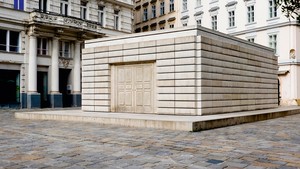
Rachel Whiteread’s Judenplatz Holocaust Memorial (2000) in Vienna. Photo: Stephen Burrows/Alamy Stock Photo
Rachel Whiteread’s Judenplatz Holocaust Memorial (2000) in Vienna. Photo: Stephen Burrows/Alamy Stock Photo
Alison McDonald is the chief creative officer at Gagosian and has overseen marketing and publications at the gallery since 2002. During her tenure she has worked closely with Larry Gagosian to shape every aspect of the gallery’s extensive publishing program.
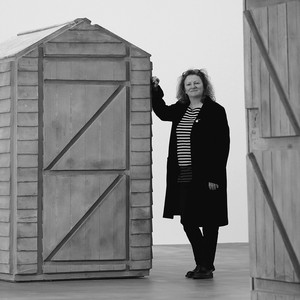
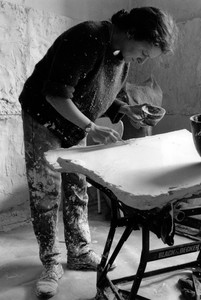
In Rachel Whiteread’s sculptures and drawings, everyday settings, objects, and surfaces transform into ghostly replicas that are eerily familiar. Through her use of the casting process, her subject matter—ranging from beds, tables, and boxes to water towers and entire houses—is freed from practical use, suggesting a new permanence imbued with memory. Photo: Dan Kitwood/Getty Images
Alison McDonaldYour work often meditates on the unseen or forgotten. I wonder about your thoughts on the way history gets written.
Rachel WhitereadOne of the most striking things about history is how it repeats itself—time and time again, seemingly with little remorse. Especially with everything we are experiencing at this moment. It makes one aware of how artists and museums have a responsibility for recording history and keeping it alive so that eventually, hopefully, we can learn not to repeat past mistakes. The job of an artist is to try to work as a cipher, to bring clarity in a creative way.
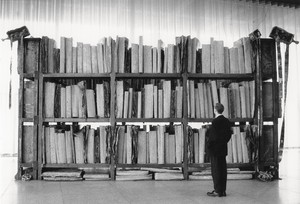
AMOver twenty years ago you designed the Judenplatz Holocaust Memorial in Vienna. This was a complicated project for many reasons, but the finished work is remarkable in its ability to distill such a massive and emotionally charged part of history. For generations into the future this sculpture will pay tribute to countless lost lives. The work is incredibly powerful, yet meditates in a place of quiet.
RWWell, reflection is an incredibly important part of grieving and also of understanding. You can’t understand something through instantaneous response. It takes time to pick over what’s happened and learn from it.
AMCan you elaborate on how you approached the proposal?
RWIt was completely daunting. My research was wide and varied. If I hadn’t lived in Berlin for eighteen months, I would never have attempted to make a proposal. In Berlin, I could feel the traces of trauma and of knowing that Germany had spent an enormous amount of time, resources, and intellect attempting to better understand what had happened and why it had happened. In Vienna that trauma is still very present.
AMThe structure resembles both a library (a source of knowledge and empowerment) and a bunker (a means of protecting oneself). The books that line its walls are all the same size; the leaves of the books face outward and the spines face inward. There are engravings in the ground around the sculpture that record all the camps where Jewish people were murdered. And the sculpture sits on the site of a historic Jewish temple and across the plaza from a very different kind of statue, of the eighteenth-century writer Gotthold Ephraim Lessing. Would you take us through some of these details and the decisions you made along the way?
RWIt was a challenge. I wanted the memorial and the sculpture of Lessing—a sympathetic German poet, philosopher, dramatist, and voice for peace—to be in conversation, culminating in a disruptive presence within a very quiet historical square. It was part of the proposal to include the information on lives lost. I have them on the ground, but they could have been presented as just a small plaque, or any other way. As for the structure, I wanted it to look like a bunker. That was something I was very clear about. A lot of the research I’d done was looking at historical bunkers. I wanted it to be quite brutal, but also sensitive. So the idea emerged to incorporate books, to cast it as a library. The books could be anything—I cast their spines inward so there’s no information clarifying specifics about them. They can be read as lists of names, Jewish history, world history, poetry, whatever the viewer wants them to be. What I like to do with my work is leave things so there’s an opening for interpretation.
RWThere are two holes where the doorknobs were. They’re small circular apertures—the only things you can see from the ground that are slightly open, almost like eyes.
AMHow do you see that piece now, so many years after you created it?
RWWell, I’m extremely proud of it. And I’m always very touched by how moved people are by it. When I made the work I cast extra books because I thought the work would get vandalized. In fact it’s been incredibly well respected. And the other thing people don’t typically know about the work, because it’s rarely photographed from the top, is that at the center of the roof there’s a big ceiling rose with a hole. When it rains the water pours through it, and for me that’s always felt like tears running through the sculpture.
AMThe site was originally a medieval synagogue, right?
RWYes. When it first opened, I worked with the architects, who designed a structure of packed mud under the sculpture that included medieval remnants of the former synagogue. There were two rooms, which now are a Jewish study center, that had a lot of information and drawings of mine. That original exhibition has come down. Still, that was a whole other layer to the work.
AMAs an artist who has made many different temporary and permanent public sculptures, and who has talked about your interest in studying people’s interactions with memorials (making rubbings to record loved ones’ names, bringing flowers, leaving candles or stones, etc.), I wonder if you have thoughts about the distinctions that might exist between public sculptures and memorials?
RWIt’s a difficult issue. Memorials tend to be very serious, while outdoor sculpture can often be very playful. But they can both be plopped in places where they’re completely inappropriate, and for me, the placing of memorials and sculptures is very important. It’s something that I do. It’s part of my language. It’s how I think. I’ve always been interested in urban planning and architecture and things like that—in why things get put where they are and what decisions informed the choice. And often it’s just a bunch of red tape—that might be one difference. Lots and lots of people are making a decision and as an artist you need to have the confidence to stand firm. And that’s something I can do, but it’s exhausting. Yet these works can be very worthwhile.
Memorials tend to be very serious, while outdoor sculpture can often be very playful. But they can both be plopped in places where they’re completely inappropriate, and for me, the placing of memorials and sculptures is very important.
Rachel Whiteread
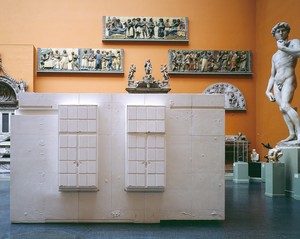
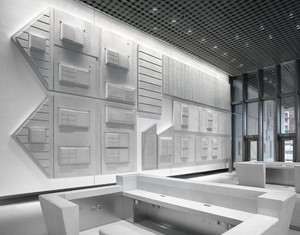
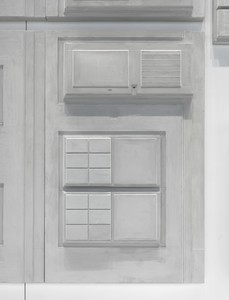
AMYou cast Room 101 of the BBC’s London headquarters, Broadcasting House, where George Orwell worked during World War II—a room that’s been discussed as possibly inspiring the dystopian novel 1984 [1949]. Can you talk a bit about that project, and about the traces of history you felt in the space that resonated for you?
RWWell, I was approached with the idea of casting Orwell’s office, which was really enticing. It was a complicated work to make because it was up ten flights of stairs, with lots of corridors, and no lifts were working. The building was under construction and we had a limited amount of time there. When we first came across the room it was full of massive industrial aluminum boxes and pipes and electrical wires and whatever, which we ripped out very roughly. Consequently the room looked like it had been under fire, like it had been in a war zone. So we cast that. Orwell was a fantastic writer and this work recalled the time he spent at the BBC. It later informed how I make the Shy Sculptures [2018–], which are almost antimonuments.
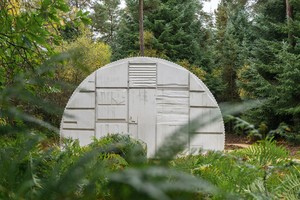
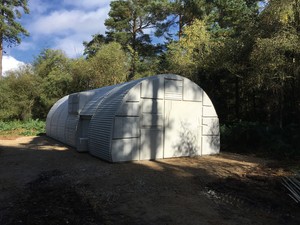
AMOne of your Shy Sculptures is a cast of a Nissen hut, a simple prefabricated building that was economical and portable, produced in response to supply-chain shortages of building materials during World War I. Human creativity in response to the limitations of materials in short supply during the war is a fascinating topic in World War II as well, and in fact Nissen huts grew in popularity during World War II.
RWI was asked to make a piece in Dalby Forest in Yorkshire, so I visited a number of sites. I responded to the history of this particular hut—I thought, I could use that, but it was very disheveled and dilapidated. And that was actually the first piece that I reinvented: I used it as a basis and then copied the plans of a Nissen hut. It was about invention as much as casting the actual object that was there. And it’s enormous. While it was the location that really attracted me to do it, the idea of making something within this forest, I was also intrigued by how Nissen huts are set up. They’re still used now, actually: they’re like permanent tents—there was brickwork, there was woodwork, there was corrugated iron. I bought all of the supplies, put them together, and then I cast it. There’s something special about the way these buildings exist in kit form and are transportable, being made on a drawing board and then clipped together to become a home, hospital, storage shed, or ammunition store. They were adaptable buildings.
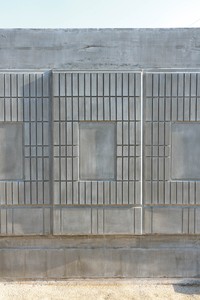
Rachel Whiteread, US Embassy (Flat pack house), 2013–15, concrete, installed at the US Embassy, London. Photo: Mike Bruce
Rachel Whiteread, US Embassy (Flat pack house), 2013–15, concrete, installed at the US Embassy, London. Photo: Mike Bruce
AMFor the US Embassy in London you created a sculpture of a flat-pack house—a home delivered in a box. This type of portable housing furnished living quarters for military personnel through both world wars, as well as during England’s colonial expansions, the gold rush in the United States, and so on. How does this sculpture bring forward ideas of “home,” or “a home away from home,” or a “longing for home”?
RWWell, the location of that work is very different. People are often going to embassies to get visas and such, and those moments are often accompanied by feelings of fear or anxiety, that things might not go the way they’re hoping. There’s a strong sense of authority. You also have to understand that the embassy was being constructed as I was making the sculpture, so it was hard to envisage what was going on. But I just kept thinking about the people, and the fact that there was this thing about inside and outside going on, and the feeling you get when you’re between two places. Borders are set up to divide us, to divide people, and if you have any sense of humanity, you don’t want that division to be there. You want it to be open, but obviously it can’t be, there are borders—that’s how we’ve constructed the world.
AMIn earlier conversations you’ve recounted how large areas in Britain were devastated by bombing raids during World War II.
RWI am part of the generation where my parents were very young, perhaps about seven, when all of this was happening. My father was in London until he was sent out as an evacuee and had a terrible time in the countryside. And my mother was in Liverpool, which was also very badly bombed, she was staying in shelters and would play on the bomb sites. Lots of my friends’ parents had very similar experiences. And having parents who were very much a part of that without doubt becomes part of your psyche, because it’s stories that they tell you. My grandfather on my father’s side was a conscientious objector, and on my mother’s side he went to war. So we had experiences on both sides. One grandfather was very political and went to prison—to stand up like that within a family of working-class people was a very, very tough thing to do, even though that whole family just didn’t agree with violence. It scarred him all his life, and it probably scarred my father as well. My mother had very different experiences, where her father, who had gone to war, had terrible nightmares. These things become part of your own history and experience. I’m a sponge for emotion and other people’s trauma, and that affects me.
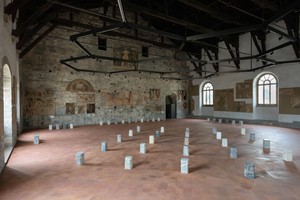
Rachel Whiteread, Goodwood Art Foundation, Essex, England, May 31–November 2, 2025
Alison McDonald is the chief creative officer at Gagosian and has overseen marketing and publications at the gallery since 2002. During her tenure she has worked closely with Larry Gagosian to shape every aspect of the gallery’s extensive publishing program.
In Rachel Whiteread’s sculptures and drawings, everyday settings, objects, and surfaces transform into ghostly replicas that are eerily familiar. Through her use of the casting process, her subject matter—ranging from beds, tables, and boxes to water towers and entire houses—is freed from practical use, suggesting a new permanence imbued with memory. Photo: Dan Kitwood/Getty Images