An exhibition at Gagosian, Hong Kong, brings together three of James Turrell’s Glasswork pieces along with site plans, photographs, and models of his Skyspaces and Roden Crater. Here, Alice Godwin explores the history of the Glassworks and their relationship to the artist’s wider practice.
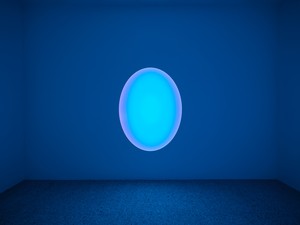
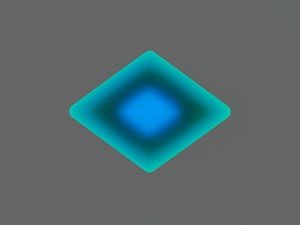
James Turrell, Resolute, 2025, computer-programmed LED panel and mixed media, 72 × 54 inches (182.9 × 137.2 cm). Photo: Thomas Lannes
James Turrell, Resolute, 2025, computer-programmed LED panel and mixed media, 72 × 54 inches (182.9 × 137.2 cm). Photo: Thomas Lannes
Alice Godwin is a British writer based in Copenhagen, whose focus is the Nordic contemporary art world. An art history graduate from the University of Oxford and the Courtauld Institute of Art, she contributes to publications such as ArtReview, Frieze, the New York Times, and Wallpaper.
In James Turrell’s Glassworks, a series begun in 2001, shifting hues evolve over a period of time behind a silhouette of etched glass. In the ellipse-shaped Resolute (2025), for example, inky blue dissolves into coral into purple into blushing pink, the changing light emanating into the surrounding space and casting a meditative spell. It seems to mirror our own rhythmic breath, pulsing and swelling. The element of time is vital in Turrell’s work; the slow progress of color invites us to contemplate light’s ephemeral yet physical nature. Nothing arrives abruptly. Color unfolds in the same way as consciousness, and thoughts are suspended inside light.
Turrell, the lauded California artist who has devoted his life to understanding light, color, and perception, has often described his fascination with “the music of the spheres” and “the timing of twilight.”1 The Glassworks echo this, evolving over the forty-five to eighty minutes that Turrell suggests it takes for the soft light in the wake of sunset to dissipate and the black curtain of night to fall. As Los Angeles County Museum of Art director Michael Govan has noted, much of Turrell’s work is divined by “cycles of times and the light of celestial bodies in motion, the metaphysical music of the spheres.”2 Turrell tunes us in to a cosmic frequency ordinarily drowned out by the noise of daily life.
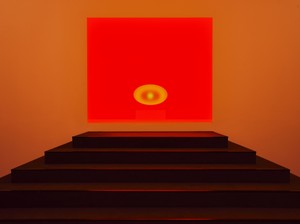
The Glassworks may take the shape of ellipses, diamonds, circles, rectangles, or squares, each with its own formal and architectural resonance that informs our impression of its metamorphosing hues. Behind the pane of glass is a shallow space cut into the wall, in which the bulbs are placed. This indication of the void behind the surface makes us feel as though we might reach out and penetrate the two-dimensional plane, only to be confronted with its flatness and denied entry to the otherworldly portal. These celestial thresholds hover between invitation and refusal.
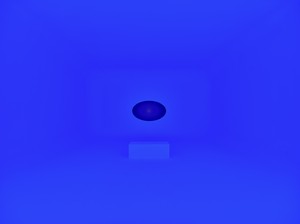
James Turrell, All Clear, 2024, from the series Ganzfeld, 1976–, light installation and mixed media, dimensions variable. Photo: Thomas Lannes
James Turrell, All Clear, 2024, from the series Ganzfeld, 1976–, light installation and mixed media, dimensions variable. Photo: Thomas Lannes
The Glassworks build upon Turrell’s early architectural interventions at the Mendota Hotel in Santa Monica. Starting in 1966, the young artist went from projecting light onto his studio walls to blocking out windows and cutting actual apertures into the building to allow light to penetrate from the outside in, like an enormous camera obscura. This strategy would lead to the Shallow Spaces (1968–), in which a false wall placed in front of an existing wall appears to float, with light bulbs installed in the gap between the two. As the artist explains: “With these Shallow Spaces, I could yield a light space where it was on the same plane as the wall: three dimensions seen as two, until you came up close to it.”3
The Glassworks toy with the same illusion of flatness versus endless depth, not only in their structural elements, but in the apparent density of color that emerges from their forms. In Turrell’s hands, light possesses both volume and surface. He delights in the marvelous ambiguity between three-dimensional space and the two-dimensional picture plane, where light exists somewhere between sculpture, installation, and painting. Through this ambiguity, he invites us to question the imperfections of our perception, playing upon assumptions of the possibilities of light—its simultaneous fleetingness and physicality. Serena Cattaneo Adorno, director at Gagosian, reflects on Turrell’s work: “This delicate interplay between presence and immateriality evokes the Zen philosopher Dōgen’s insight that ‘The moon does not become wet, nor is the water broken.’ Just as the moon’s reflection on water remains untouchable, Turrell’s light defies tangibility while profoundly transforming our perception of space. His works elude ownership or fixed form, existing instead as ephemeral moments shaped by light, atmosphere, and the attentive gaze.”
“My work is about your seeing,” Turrell has remarked, reminding us that perception itself is his true medium.4 At the same time, the artist repeatedly destabilizes the authority of the eye. Vision, in his hands, becomes something tactile, vulnerable, and strangely fallible. As Maurice Merleau-Ponty observed, “Vision is not a certain mode of thought.”5 For Turrell, seeing is an embodied encounter with uncertainty.
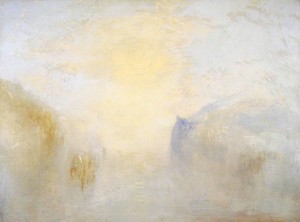
J. M. W. Turner, Sunrise, with a Boat Between Headlands, c. 1840–45, oil on canvas, 36 × 48 inches (91.4 × 122 cm), Tate, London
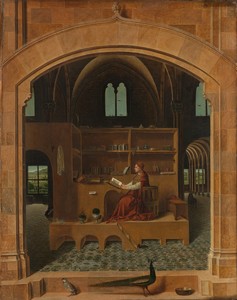
Antonello da Messina, Saint Jerome in His Study, c. 1474, oil on limewood, 18 × 14 ¼ inches (45.7 × 36.2 cm), National Gallery, London
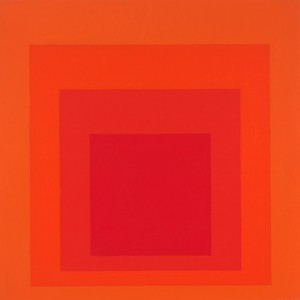
Turrell’s works have often been linked to painting, thanks to both the Albertian theory of a painting as a window and his painterly treatment of color in pieces like the Glassworks. The artist’s rich understanding of the ways we perceive color, through the eye’s translation of light, resonates with Josef Albers’s chromatic theories and explorations of the relativity and instability of color, in which perception itself was always the determining force. The luminous kaleidoscopes of the Glassworks can be related to the plein-air painting of Claude Monet, the Romantic vistas of J. M. W. Turner, and the color fields of Mark Rothko. But beyond painting, as the art historian Martin Gayford notes, “Turrell adds (quite literally) new dimensions. There is real space behind the glass, and his works unfold through time in a way that Turner, for example, could only hint at.”6
Initially made using neon bulbs, the Glassworks would later embrace LEDs, which are more energy efficient and durable. For Turrell, the arrival of light-emitting diodes presented new opportunities to program light. As the artist once explained: “Art is a statement and it can be facilitated by new technology. Now LED technology is changing the possibilities in my work.”7 If anything, he was surprised it did not come along sooner. In a conversation with Govan, the artist was reminded by the curator that he had a dream as far back as the 1960s of being able to program remotely a light bulb’s changing colors.
The first works to employ LEDs were public projects at Zug Railway Station in Switzerland and the Jacques Ripault–designed PSA Peugeot Citroën Design Center in Vélizy, France, both unveiled in the early 2000s. The development of LEDs has also permitted Turrell to bring to life discoveries related to light and perception that emerged from his time in the Art and Technology program at the Los Angeles County Museum of Art in the late 1960s. During this formative project, he was examining perceptual experiences like sensory deprivation with the artist Robert Irwin and the psychologist Edward Wortz. At the time, Wortz was helping to prepare NASA astronauts for space travel.
James Turrell, Patmos, 2024, computer-programmed LED panel and mixed media, 48 × 66 inches (121.9 × 167.6 cm). Photo: Thomas Lannes
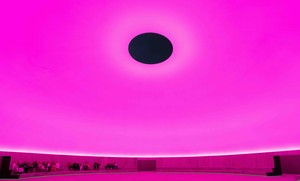
James Turrell, As Seen Below, 2026, permanent installation, ARoS Aarhus Art Museum, Denmark. Photo: Mads Smidstrup, courtesy ARoS Aarhus Art Museum, Denmark
Among the key artworks to emerge from those investigations were Turrell’s Ganzfeld installations—disorienting fields of color that recall the phenomenon felt by pilots when they fly through dense fields of cloud or fog and lose the ability to discern sky from ground. Turrell is an ardent pilot himself, and his observations from the sky have deeply informed his understanding of light and color, and the effects of altitude and atmosphere. LED lighting systems have made possible the Ganzfelds’ precisely controlled environments, as in installations like All Clear (2024). And yet, “Technology does not make good work,” Turrell has said. “You can still write a poem on a brown paper bag, and haiku as just as profound as the Pyramids.”8
There is an intimacy to the Glassworks that facilitates a connection between Turrell’s art and the viewer. As Govan puts it, “No science can explain the uncanny feeling that there is no space, no difference, between us and the object of our perception.”9 In contrast to the vastness of some of Turrell’s installations, like the extraordinary Skyspaces—cut openings to the sky within architectural space that recall the grandeur of the Pantheon in Rome—the Glassworks evoke the scale of the human body. There is a rapport between the hollow behind the glass plane and the corporeal cavity, the perception of fluctuating hues and the human eye. Over time in their presence, this relationship grows, nurturing the sensation of sharing the gallery with another, otherworldly being. The ethereal feeling of light might be attributed to Turrell’s roots in the Quaker church and its foundational belief in an inner, divine light.
This summer, the ARoS Aarhus Art Museum in Denmark will unveil Turrell’s largest Skyspace to date, in a vast dome designed by the architectural firm Schmidt Hammer Lassen. Whereas the sky comes down to meet us in such transcendent spaces, the Glassworks invite us into an encounter with light on different terms, though terms undoubtedly still rooted in the celestial movement of the spheres.
2 Michael Govan quoted in “Inner Light: The Radical Reality of James Turrell,” in A Retrospective: James Turrell, ed. Michael Govan and Christine Y. Kim (Los Angeles: Los Angeles County Museum of Art; Munich: Prestel Verlag, 2013), p. 18.
3 James Turrell quoted in Christine Y. Kim, “James Turrell: A Life in Art,” in A Retrospective: James Turrell, p. 47.
Alice Godwin is a British writer based in Copenhagen, whose focus is the Nordic contemporary art world. An art history graduate from the University of Oxford and the Courtauld Institute of Art, she contributes to publications such as ArtReview, Frieze, the New York Times, and Wallpaper.