The Many Shades of Elaine Kraf
As part of a growing posthumous appreciation of the feminist writer Elaine Kraf, her previously unpublished novel Memory House was released by the Modern Library. Here, Alana Pockros explores Kraf’s iterative worlds.
Summer 2026 Issue
The most recent edition of Picture Books, an imprint organized by Emma Cline and Gagosian, pairs Mary Gaitskill’s novella STAUF: A Tragedy with Jill Mulleady’s painting The Shift. In celebration of this forthcoming publication, Gaitskill and Mulleady discuss the myth of Faust, good and evil in the digital age, and the channeling of raw matter into art.
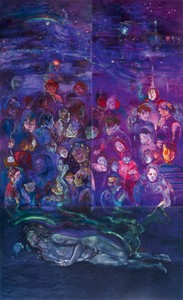
Jill Mulleady, The Shift, 2026, oil on velvet, in three parts, overall: 14 feet 9 ¼ inches × 8 feet 9 ½ inches (450 × 268 cm)
Jill Mulleady, The Shift, 2026, oil on velvet, in three parts, overall: 14 feet 9 ¼ inches × 8 feet 9 ½ inches (450 × 268 cm)
Mary GaitskillI was really surprised and delighted when I first saw your book of paintings Fight-or-Flight [Swiss Institute with Lenz Press, 2025]. The first painting, A Fantasy of Transcendence and a Preoccupation with Downfall and Ruin [2019], is a striking image: It shows this large man lying on a sort of island, with many small dramatic stories or images going on behind or under him. He looks tortured, there’s actually a wound in his body, yet he’s very large and has a sense of power about him. The title really got my attention—I thought it was so resonant with the legend of Faust, and with my novella’s
interpretation of it, because the character in my story, Tina Stauf, perceives herself in a society on the precipice of downfall and ruin and is feeling her own utter inadequacy in dealing with that. She feels that everything she’s counted on to get her through and to help other people is completely false now. Despite this, she’s got a fevered desire to transcend all that, and to transcend her own limitations in life. So this painting really struck me, because it conjures a bigger social feeling of and preoccupation with ruin.
Another painting farther in the book, Feral [2021], shows a cat dragging a dead bird. It’s such a powerful image of raw instinct and violence that’s not immoral, just amoral. And that’s also very much a part of my story: At one point the character—before she’s even met the devil—is looking at the decaying yard of her parents’ house. Her parents are religious fundamentalists and she’s there to be supportive of her sister, who is undergoing an exorcism ritual that Tina thinks is absurd and twisted. But she’s there. She’s in a state of great emotional upset and is looking out at this yard and just feeling the raw force of life—which she used to believe was infused with love, but now can no longer believe in. She’s accepting that. I don’t know if “acceptance” is the right word, but seeing in these paintings this raw force that’s really beautiful—not just in Feral but in some of your other works too—I find that very powerful. So I was happy that you were going to contribute to this Picture Books collaboration.
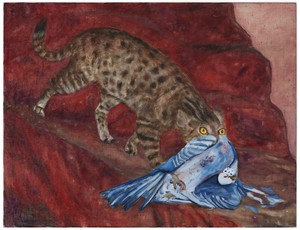
Jill Mulleady, Feral, 2021, oil on linen, 19 ¾ × 25 ⅝ inches (50 × 65 cm)
Jill MulleadyWhat you’re saying totally resonates with the paintings. In the title A Fantasy of Transcendence and a Preoccupation with Downfall and Ruin I see something that relates to your story. It’s also a fiction, but it resonates with different levels of reality that are part of human existence, starting with the myth of Faust but also relating to psychology, and to today’s leaning to make psychology almost a replacement for religion. There’s an existential crisis and a loss of faith, a strong loss of faith, which comes from your protagonist Tina’s rejection of her own family’s religion. As you said, it’s not a moral position but rather an engine for her to find her own truth. It shows the desperation that comes from not being able to find it in society, in relationships, even though she tries with psychology, which is a more modern way to find meaning. And then when her patient commits suicide, it’s a total failure of finding truth. It’s almost like the second failure, because the first is that she doesn’t share her family’s beliefs or religion; now she doesn’t believe in psychology anymore either, so she tries to find it in love.
It’s in her incapacity to find a real connection that Faust comes in. It’s interesting—your interpretation of Faust is totally different from Goethe’s. The Faust of his poem [1772–1832] comes to rule the world and to be a powerful person; it’s a masculine image. Yours is a woman who just aims to understand why human beings act the way they do. Tina Stauf is searching for something missing, and that’s why the story’s so contemporary and enlightening, because as a society we have a desire for transcendence that goes unmet.
MGHave you read Meghan O’Gieblyn’s book God, Human, Animal, Machine [2021]? She writes about AI. She grew up in a fundamentalist family—like my character—and was a believer into college, and she talks about AI and the obsession with creating a superintelligence, or almost like a demonic intelligence. She connects that very much with the religious impulse, as if that intelligence were almost a perverse version of a new god. That’s not an unusual idea, but O’Gieblyn goes into unusual depth, supported by philosophy and history. She also has a refreshing openness to mystery.
It’s a transcendence of the physical: In the old world [of the Faust legend], blood is the ultimate because it’s connected to the body, whereas in this contemporary story they’re crossing over into an electronic world, a medium that’s no longer about the earth.
Mary Gaitskill
JMI haven’t read it, but I understand the concept. People now open up to AI sometimes more than they open up to humans, because they feel like they can share everything. Then what they’re sharing becomes part of this massive archive of information and it has a capacity that no human has. And here we are. This exchange with AI actually could be a sort of transcendence. To what? We don’t know.
The work I’ve paired with your novella, The Shift [2026], depicts the moment when the body exhales the last breath of life and inhales the first one of death. It’s the shift from one world to the other one. It’s very much related to your contemporary version of Faust. Your character Tina makes a pact with the devil, represented by the character Mephista—it’s funny that she signs an electronic signature. Mephista comes to Earth somehow and proposes the exchange: She will serve Tina during life if Tina will serve Mephista during death. What Tina is doing is finding that ultimate trust in Mephista, because they’re now united forever. It’s almost like a religious marriage.
MGWell, they’re going to have a strange relationship. It’s more like ultimate treachery on the most intimate and cosmic level imaginable. Which I guess could describe religious marriage. About the signature, it’s funny because in Faust they sign in blood, and Mephistopheles says, “Blood is a quite special fluid.” My character Mephista says, “Blood is a very fascinating ink, but this is actually more binding,” and they make the electronic signature. It’s a transcendence of the physical: In the old world, blood is the ultimate because it’s connected to the body, whereas in this contemporary story they’re crossing over into an electronic world, a medium that’s no longer about the earth.
JMCrossing over—being alive and then dying and going to the other side—is something you navigate with this idea of selling your soul in the afterlife; you’re engaging with someone beyond life. One thing we know about death is, we die alone and we don’t know where we’re going or with whom. But here, they’re signing to go to the other side together. Which is almost like a romantic story, because why would you accept that otherwise? Tina is seduced by Mephista. Mephista uses extreme empathy actually; she’s very compassionate, very seductive, and gives Tina the connection she was craving, which are all things related to an idea of love. But the love is transactional, not unconditional: I give you something now and you will give it back to me later. It’s an exchange. But is she doing a terrible thing by looking for transcendence? The question that resonates with me is, Is love a tragedy?
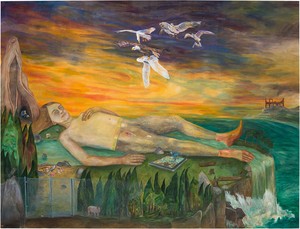
Jill Mulleady, A Fantasy of Transcendence and a Preoccupation with Downfall and Ruin, 2019, oil on linen, 133 ⅞ × 177 ⅛ inches (340 × 450 cm)
MGIt’s an interesting question; I’ve thought about it myself. In [F. W.] Murnau’s film version of Faust [1926], Faust sells his soul because he’s in the middle of a plague and he can’t heal people; he’s frustrated that he can’t help people in the way he would like. There’s a little of that in Goethe’s book also, but not so much. So that’s how the devil seduces Faust originally. He also seduces him with, you know, sexuality and beautiful women, but his offer is, “I can help you do good this way.” And there’s that line—“I am he who, wishing only ill, does only good.” It’s an interesting statement. And yes, both Stauf and Faust are seduced with the idea of doing good, of helping, becoming a better therapist, loving. Love is good; it’s hard to see love as a bad thing, and Mephista is promising Tina love. But it’s a seduction, because it will lead to nothing good. As in the book, Faust tries to do good, but it always ends bad.
And I think the idea is—I mean, it depends on whether you believe in evil or not, but I think evil often presents as something idealistic and wonderful. Fascism presented itself as something wonderful: self-respect, belief, hard work, motherhood, beauty. Almost every bad thing you can think of at first presents itself as something ideal. Then there’s the concept of integration, which, because my character is a therapist, comes up quite a bit in the story. I think about William Blake’s Marriage of Heaven and Hell [1790–93], a beautiful poem: It’s the idea that heaven and hell work together, that there’s always a joining of good and evil, or they blend. I question that, but it’s true that at a certain point, the universe is made of things that are completely outside our comprehension and by human standards would be really evil. You know, animals are tortured and eaten by us. Is that evil? That’s just what we do; animals devour other animals. It’s just a part of what happens. You want to call that evil? I don’t know.
JMIs evil more about what has no name? Tina rejects the religion of her family, she rejects her training and career in psychology—everything that she knew how to name—and then this entity comes from the other side and she’s offered this deal. The question is, Would you accept a deal with uncertainty? “You don’t know what’s going to happen after your death, but you’re going to have to serve me.” But maybe it’s actually not so bad to serve her?
MGIn the story Faust, at least the Goethe version, at the end Faust and Mephisto do become friendly. I mean, they bicker constantly, they’re funny, like Laurel and Hardy: “This is another nice mess you’ve gotten me into.” They have a kind of odd companionship. And the devil—or Mephisto isn’t totally the devil, he’s a minion of the devil, really—is kind of comical. At the end, when he finally swoops in to get Faust, angels appear and they’re like, “No, you can’t have him; we actually kind of like him.” Then they flirt with the devil and torment him with their beauty.
JMThat’s what I mean—evil as the fear of the unknown, the fear of what’s different. Tina has courage when she signs the deal, and is it a happy ending somehow?
MGAt that point, yes. Goethe’s Faust also has a happy ending.
JMIs it almost like a romanticization of evil?
MGIt could be, except I’m not sure—Faust does do some genuinely very bad things by accident.
JMLike what?
MGWell, he destroys the girl he gets involved with. She’s pregnant, she’s cast out of society, she’s arrested.
JMYes, yes, it’s terrible. With the baby I also remember these images from Murnau’s film.
At the end of the day, for me it’s all about making fiction out of what’s real. Not about the result but about the roles we play in life as a writer or a painter, how we process things to be able to make the work.
Jill Mulleady
MGShe kills the baby, unwittingly, but yes, it’s bad. And Mephisto actually kills her brother. Her family is destroyed, and then later he destroys the lives of some benevolent old people who helped him and destroys an entire city. So Faust intends to do the right thing, it just never works, which is somehow very familiar.
JMMaybe, at the end of the day, it’s a way to portray the complexity and contradictions of human nature.
MGYes, and I’m not sure how I’m going to end my story. I’m not sure I’m capable of it, frankly. But I want to write something more. I imagine there’s already a kind of closeness between Stauf and Mephista, and then at some point in the story’s future she’ll see Mephista’s vulnerability and tragedy and feel for her. Because I do believe in cosmic evil—it would be very hard for me to define it, but I know it when I see it—and there’s always a tragedy about it, something very pitiable.
JMThere’s another theme in your novel: healing. Tina is a therapist, and at the core of her every decision there’s the idea of trauma and repair. She tries to heal others but the path becomes traumatic when her patient commits suicide.
MGYes, and her mentor has died also. She’s not really believing in what she’s doing anymore. And she wants to go for sexual healing; she wants to heal an incel. I don’t know how I’m going to work with that [laughter].
JMThat’s a big challenge. I think Emma Cline’s idea of bringing us together was brilliant, because we’re thinking about similar topics in our works.
MGYeah, when I see work like yours that has so much depth and resonance with what I’m thinking about, it helps my mind work in a semi-conscious way.
JMAt the end of the day, for me it’s all about making fiction out of what’s real. Not about the result but about the roles we play in life as a writer or a painter, how we process things to be able to make the work. Which comes first, the egg or the chicken? We’re born and we have a childhood and then we do what we do—you write, I paint—and it’s nurtured by our experiences, but at a certain point you start living for your work, in a way. And that could be a sort of pact with the devil, because it’s something that serves you, or carves a connection with the world, and then you have to serve the work forever somehow, too. And what’s the cost of human connection? To write a book or to make a painting, you have to go through solitude, because you have to spend many hours on your own. I think when we have a more mature practice we know that we go through life in a way that that’s going to serve our art; it changes how we connect with life. I don’t know if you feel something similar?
MGYes, although I sometimes feel that when my writing works best for me, it does connect with something beyond me, but I can’t make that happen—it happens or it doesn’t. And sometimes it seems very small. I was on psilocybin a couple years ago, a pretty high dose of psilocybin, and I was kind of staggered by what I was feeling. I remember the person I was with said something like, “What about your work?” And it seemed very strange. I said, “That’s just some weird thing that human beings do.” That’s what it seemed like to me. Meanwhile there was this raw matter of life surging all around me. But I think when your work is good, you’re able to at least channel some of the raw matter.
Artwork © Jill Mulleady
Mary Gaitskill, STAUF: A Tragedy / Jill Mulleady, The Shift (New York: Picture Books | Gagosian, 2026)
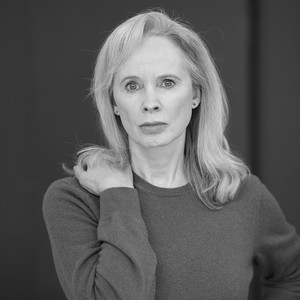
Mary Gaitskill is the author of the story collections Bad Behavior (1988), Because They Wanted To (nominated for the 1998 PEN/Faulkner Award), and Don’t Cry (2009), and of the novels Two Girls, Fat and Thin (1991), Veronica (nominated for the National Book Award in 2005), and The Mare (2015). Her stories and essays have appeared in The New Yorker, Harper’s, Artforum, Granta, and many other journals, as well as in The Best American Short Stories and The O. Henry Prize Stories. Photo: © Derek Shapton
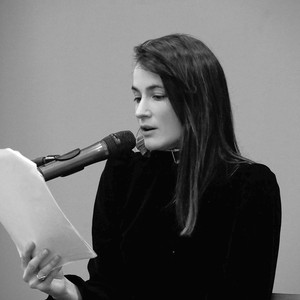
Jill Mulleady was born in Montevideo, Uruguay. She is Swiss-Uruguayan and grew up in Argentina; she is now based in Los Angeles and Paris. Mulleady primarily works in painting and often intervenes in the spaces in which she exhibits, staging her paintings with readymades, sculptures, films, and architectural installations.
As part of a growing posthumous appreciation of the feminist writer Elaine Kraf, her previously unpublished novel Memory House was released by the Modern Library. Here, Alana Pockros explores Kraf’s iterative worlds.

Sally Mann joined novelist Amor Towles in a conversation about her widely celebrated new book, Art Work: On the Creative Life (2025), at an event hosted by the New School and the Strand in New York. Published by Abrams, Art Work is about the challenges and pleasures of the creative process. Its mix of illuminating stories, practical advice, and life lessons, illustrated throughout with photographs, letters, and journal entries, offers insights into Mann’s own experience of making art. Here, Mann and Towles speak about the writing process, historical ghosts, and fortunate mistakes.
The Quarterly’s 2026 fiction writer, Helen Oyeyemi, kicks off her series with the first installment, “Introduction to a Genie (of Sorts).”
The fourth and final installment of a short story by Catherine Lacey.

Francesca Wade’s new biography of Gertrude Stein sifts through the writer and collector’s layered life and legacy. Here, Wade speaks with the Quarterly’s Gillian Jakab.

The third installment of a short story by Catherine Lacey.

The second installment of a short story by Catherine Lacey.

The first installment of a short story by Catherine Lacey.

We present the final installment of a four-part short story by Arinze Ifeakandu.

We present the third installment of a four-part short story by Arinze Ifeakandu.
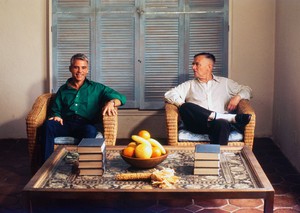
Katherine Bucknell, previously the editor of a four-volume edition of Christopher Isherwood’s diaries, has now published Christopher Isherwood Inside Out, an intimate and rigorous biography of the celebrated writer and gay cultural icon. Here she meets with Josh Zajdman to discuss the challenges and revelations of the book.
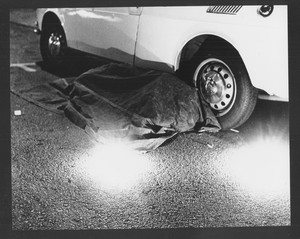
Sydney Stutterheim has published Artist, Audience, Accomplice: Ethics and Authorship in Art of the 1970s and 1980s (Duke University Press, 2024), a survey of performance art and related practices that involve, in various manners, the figure of the accomplice. To celebrate the publication, the Quarterly is publishing an excerpt that examines Chris Burden’s Deadman (1972).